Showing posts with label Andrew E. Colarusso. Show all posts

Thursday, November 10, 2016

Views from the Tower: Election 2016

by Andrew E. Colarusso


Many of us, people on the outside of what's inside, are feeling today like we've been let down. Like we've been told (again) that we are collectively unwelcome in a nation that consistently demands our labor. On more than one occasion I've heard it said that election disappointment felt like the heartbreak of a first love lost. Thankfully, hearing it from others validated and gave expression to exactly how I felt on Wednesday morning, leaving my home to face a seemingly different America. My chest was constricted, my psyche excessively sober, and somewhere, elsewhere within me, I felt torn, returned to the irreparable fracture of an inherited nullity. The loneliness, I'm ashamed to say, felt familiar. Heartbreak—and in that way specific to romantic heartbreak. I perceived my own feeling as selfish, even detestable. Why? Why should I feel this heartbreak when, cognitively, I recognize there is much political work to do in the wake of a devastating verdict? 

In an unfortunately insidious way, nothing had changed between Tuesday and Wednesday. What an electorate expects and desires in their candidate is a representative of its best interest. It's part of democracy. And though our Democrat (who ironically resembles a republican elite) won the popular vote, the electorate decided on the Republican (who's ironically run, in my opinion, a campaign built on democratic rhetoric). Republican voters had already decided they were tired of the otherness parading itself in the halls of governmental authority, in media, in all channels of power—buying into the notion that a black President meant the end of American racism. These voters felt their tax dollars no longer served their best interest and found clarity in a figure who voiced the worst of their frustrations (despite himself not having to deal with any of these frustrations on a daily basis). Racism, sexism/misogyny, chauvinism—all of these things, despite their never having disappeared, have reared new ugliness into the American socio-political landscape. This election was certainly a reminder of what skeletons remain trapped in the closet of American democracy. 

But why this heartbreak? And why my negative self-perception of this feeling? Well, I think this has to do with the erotics of national identity. As Audre Lorde reminds us, the erotic is a form of power. 


THERE ARE MANY kinds of power, used and unused, acknowledged or otherwise. The erotic is a resource within each of us that lies in a deeply female and spiritual plane, firmly rooted in the power of our unexpressed or unrecognized feeling. 

The erotic, as you likely already know, is a term derived from the Greek embodiment of desire, eros—it is a term specific to sexual/romantic love (as opposed to other expressions of ancient Greek love: agape, storge, and philia). More broadly, eros is desire writ large. It is to want. That we feminize the erotic is a truth often unacknowledged. And as a man (conditioned to reject the feminine within me), I was rejecting what came from my proper spirit. 

We all live in this country in hope that we might be invested in the poetic project of inalienable rights and the pursuit of happiness. And for many of us this translates to a desire (an erotic) to be American, to be received as American, embraced as American. This heartbreak is the feeling that one is helpless in the face of patriarchal oppression, that no amount of sweet talk or apologizing can seem to fix, that the sincerest desire of the heart is ignored, unrequited, disparaged—left to fester in what Lorde (and later Spillers) refers to as the pornographic. I return regularly to this passage by Lorde:


When we look away from the importance of the erotic in the development and sustenance of our power, or when we look away from ourselves as we satisfy our erotic needs in concert with others, we use each other as objects of satisfaction rather than share our joy in the satisfying, rather than make connection with our similarities and our differences. To refuse to be conscious of what we are feeling at any time, however comfortable that might seem, is to deny a large part of the experience, and to allow ourselves to be reduced to the pornographic, the abused, and the absurd. 

We are not without power in this. It has everything to do with a desire for fulfillment in the face of structures and continuums designed to rob us of that well-spring of power. This election was no accident. Things may get worse before they get better. In fact, some of us may never be American, may never receive or be received by America (as it so happens, some of us were never constitutionally considered human). But one thing is certain, we are not without power and we should not be made to feel anything less than divinely constituted and whole. We will not be moved.

Friday, October 28, 2016

Kissing the Frog(s)

Kissing the Frog(s)
On Love and Pokémon, 
Schopenhauer and the Masuda Method

Luckily we were met by ordinary devotion. 
—D. W. Winnicott
Did you teach him how to surf, is perhaps where it started. It’s 1998. Sheldon A. Brookner. P.S. 135 on Linden Blvd. Brooklyn, New York City where they paint murals of Biggie…You’re sitting at a collapsible cafeteria table, rapt in classmate conversation, each of them bubbling with excitement over something. Some new thing. You’re not sure what. Curious, you ask: what’re y’all talking about? 

You dunno Pokémon?

Shortly thereafter you acquire as a gift from your father Pokémon Blue, the one featuring on its cover the giant blue turtle with the cannons on its back. As it happens, your parents only learn about the games overtly Bio-Darwinian themes (evolution, genetic signatures, and later, breeding) after you’re knee deep in the game’s consuming (consumerist) time-suck. In fact, the game becomes controversial (just as Harry Potter would) with Christian conservatives and you begin to feel compromised. This will happen later with Grand Theft Auto: San Andreas. Remember Hot Coffee? No,  of course you don’t. 

But back to Pokémon— On that day, you crack the box open reverently and slide the blue cartridge into your beloved Game Boy. The same day your father, ever the big man, gets into an amusing confrontation with one of the local bloods. You don’t find it funny, but later see the irony in your choice of Blue version over the more popular Red. Little Orphan Annie is blaring from trunk subs as Jay’s Ghetto Anthem climbs the charts. You notice more and more unmarked white vans making their neighborhood rounds. 

And while all of this is happening, Professor Oak (the game’s Dantean/Virgilian psychopomp) cordially greets you, welcomes you to the world of Pokémon, asks your name…

Friday, July 10, 2015

De Merveilleux Espoirs: On the work of Johanna Rocard


“In the quest for equality, black folks have tried everything. We’ve begged, revolted, entertained, intermarried, and are still treated like shit. Nothing works, so why suffer the slow deaths of toxic addiction and the American work ethic when the immediate gratification of suicide awaits? In glorious defiance of the survival instinct, Negroes stream into Hillside, California, like lemmings. Every day they wishfully look heavenward, peering into the California smog for a metallic gray atomic dot that will gradually expand until it explodes some one thousand feet over our natural and processed heads. It will be the Emancipation Disintegration. Lunch counters, bus seats, and executive washrooms be damned; our mass suicide will be the ultimate sit-in.”[i]

In this darkly comedic, decidedly pessimistic excerpt from Paul Beattys The White Boy Shuffle the idea of black agency is radicalized (has been radicalized) sometime after the 90s L.A. Riots, as a movement of mass suicide – a relational gesture in which the black body (re)commits itself to its own agency (see: Seppuku) in the face of anti-black racism and hatred. Beattys 1996 debut novel walks out the idea and possibility of radical liberation in the face of oppression the seeds of which, one might say, were planted in the popular imagination with the advent of the American Civil Rights Movement. The White Boy Shuffle imaginatively, fantastically, and fatally extends the provenance of 20th century black liberation into the 21st century an idea marched into the present. That is: if black bodies are consistently, reluctantly, inadvertently, and violently imbricated in the schemata of American capital, liberations only recourse is to deprive the system of its corporal capital.

I woke up this morning wondering: are we living through a suicidal moment? And are we, the living, tragically subsumed in the machinations of a system which tallies each slow death?

Friday, September 12, 2014

The Zealot's Guide to Jurassic Park

by Andrew E. Colarusso & Katie Smither


It doesn't take a scholar to deduce that Steven Spielberg was one of the last great movie makers of the 20th century. Ask anybody, especially children raised through the nineties, what their favorite Spielberg film is and you'll likely hear the words "Jurassic Park". In many ways it was the perfect film to inaugurate the election of Bill Clinton, baby boomer extraordinaire. Like the Clinton Administration, Jurassic Park offered excess, escape, dramatic returns, and above all, spectacle. High art may have its devoted audience, but spectacle is universal. Jurassic Park is one of the highest grossing films of all time, and continues to earn income as a successful franchise long after its 1993 debut. In fact, a fourth film in the franchise is due for theatrical debut next year (2015)

Alas, Jurassic Park, the original film, is short on plot continuity. So distracted by the spectacle, and then panic, of dinosaurs set loose in an anthropocenic world, the audience neglects to remember or even notice certain character realities. This is where the film begins to really signify. But how?

Saturday, August 23, 2014

Resisting Arrest

For my people


I. Resisting

From the latin resistere: meaning, can't stop, won't stop. The redoubling of efforts against. Entry, reentry and exit...

Wednesday, July 30, 2014

A New Center for Black History in the 21st Century

The Black Cultural Archive's new Heritage Center in Windrush Square, Brixton (London, UK)
photo by Edmund Sumner
by Andrew E. Colarusso

Brixton, in the south London borough of Lambeth, is now home to the Black Cultural Archive's Heritage Center. Opened last week, the Heritage Centre is located in Windrush Square, the arrival site of the first major Afro-Caribbean wave of immigrants to the United Kingdom. The Windrush Empire made its voyage from Jamaica to Brixton, London in 1948 carrying 492 passengers (one stowaway) and the rest is history. Brixton today carries this cultural legacy with a thriving West Indian and African community. So what is this new Heritage Center and what does it mean?

Sunday, July 27, 2014

Form Submission; Form Rejection

by Andrew E. Colarusso

Many among the thousands of us who write poetry, or assume the title of poet--in fact, all of us who have considered the possibility of an original creation being actualized in this world have also contended with rejection. It's natural to every process. We are continually engaging and negotiating the corners of our lives with varying degrees of success. But for poets (and writers in general) the rejections seem to come several at a time and consistently. This is part and parcel of the job. 

A poet asserts an idea or an aesthetic while adapting process to reach an objective aim. It's a constant push and pull, swinging back and forth between a necessary obstinance and amenability. And the poet herself is subject to much discussion and classification, especially with regard to creative output and aesthetic. i.e He's formal and lyrical; she's a feminist poet; they make conceptual pieces; we strictly write for the page. I'm doing my best not to place poets within an objectifying binary (hermetic/populist, tradition/vanguard, demotic/hieratic) Poets universally engage process, and a part of that process is dealing with the consequences of our submissions, dealing with the ways our work is received. We all get rejections...

Monday, May 12, 2014

[Early] Impressions of Kara Walker's Sphinx: A Subtlety

By Andrew E. Colarusso

This weekend I had the good fortune and free pleasure of working with Creative Time NYC at Kara Walker's installation in the now defunct Williamsburg Domino Sugar Factory. Yes I understand that the previous sentence was a lot of name dropping, but nothing as it related to this exhibit went unnoticed by the artist. 


This Subtlety (so named for a European tradition of refined and sculpted marzipan treats) is an intellectual marvel of an installation. While Kara's work has always dealt with site and scale remarkably well, this piece calls her into being just as Guernica, its nigh unavoidable tableau of degeneration, called Picasso into being. 
Enigma of the tucked thumb

The Great Sphinx of Williamsburg signifies with such subtlety the tragic irony of our human (read: flawed and American) predilection for "sweet tastes". The sculpture was first designed as a 3D model. 35 tons of white sugar were molded over 330 blocks of styrofoam and compacted to form the tremendous ephemera of the Sphinx. She, all white and melting, all violence and compelling beauty (if not, titillation), commands attention in the long abandoned space--its walls aged black with sugar and molasses. The space presents itself as slightly phobic of natural light, with its old windows located along the top of the dilapidated hall where the ceiling meets the wall. And with so much sugar coming and going from the building since the middle 1800's, you can understand why. Natural light through glass can be a powerful heating agent, and sugar does not fare well in heat. 

So we consider sugar, refined white sugar, as material. What does it signify, here in this Sphinxian representation of a black mammy? And do you remember R. Crumb? Naturally we understand sugar/molasses (both naturally dark substances) as a commodity of modernity. In this instance specifically we consider the Atlantic Slave Trade (Molasses to Rum to Slaves) and Middle Passage. The truth of this is just as unavoidable as the object Kara has created. But my mind went elsewhere.

Wednesday, May 7, 2014

The Amazing Spider Man 2 Movie Review


You see it all in 3-D
It's your favorite foreign movie
-"Peg" Steely Dan

*****
4/5 Stars

The Amazing Spider-Man 2
Like that partner you, by some miracle, managed to hold on to for a while--The Amazing Spider-Man 2 came and went in tragic-comically predictable fashion, and made for the two most beautiful and notable hours of your young life. You knew it wouldn't last, but Oh Lord did it make you feel good and leave you wanting more. And even though you experienced its beauty from the back of Brooklyn's dingiest movie theater, it felt like you were sitting in the Taj Mahal (not, in reality, the Kent) wearing Cazal shades instead of cheap 3D lenses. 

The Amazing Spider-Man 2 was a revelation. A marvelous breath of fresh air into a flagging brand, a flagging icon. Andrew Garfield as Peter Parker/Spider-Man is utterly charming in a way that Tobey Maguire could never achieve. And I found myself falling deeply and mysteriously in love with Emma Stone as the tragic Gwen Stacy. Their onscreen chemistry is real and cheesy and everything you secretly want for your friendly neighborhood Spider-Man. Dane DeHaan is a fantastically entertaining Green Goblin/Harry Osborn. He's captured as a simultaneity of doe-eyed young man-child on the cusp of his sinister inheritance. As Stan Lee has suggested, Spider-Man's greatest foe is Doctor Octopus, but Peter Parker's greatest foe is the Green Goblin. The Amazing Spider-Man 2 treats us to a fine portrait of Peter Parker qua Spider-Man and the Green Goblin as his mad nemesis. The best villains of course are those we can empathize with. Which brings me to the unexpected star of the show, Jamie Foxx as Electro.

Tuesday, March 25, 2014

Poem

Mikhtam
 by Andrew E. Colarusso 

A Sort of Homecoming, 2011
Cut paper on birch panel with UVA varnish
36 x 71 inches (91.4 x 180.3 cm)
Courtesy Andrew Edlin Gallery


Mikhtam

The clime touched down on weathered twine
tied to the hind to maginal wire and the secular
to a tuft of red hair. Native in the din easygoing
mayfolk bedgotten by march to make december
babies

Begin flagging for settlement. The hold is loosened
into a comfortable and plural slouch as one foot in
front of the other we who still stand now in the cycle
of anotherworldly condition pour into the eye into
the smell of

The secular. Maria turn against what borrowed light
we watch and gampless against the coming eyewall
whiten all reflex in preparation for what. Whiten
in my ear your breath behind me without saying
you

                                 Begin flagging for settlement
as the first thing you said when you saw it was


for Afia K

Wednesday, February 19, 2014

An [Abridged] Introduction to Parapoiesis

Having Walked Beside the Devil:
An [Abridged] Introduction to Parapoiesis


I.
Awakened from your shepherd’s dream by a curious and questioning devil (שָׂטָן). You find yourself walking at your own pace beside the devil, who walks also at your pace, amused, engaged, uneasy. Enthralled. You experience beside the devil an arousal of doubt. You choose to acknowledge this or you choose not to. “On the whole, the very mark of my genius is that Governance broadens and radicalizes whatever concerns me personally.” says the devil.  (Kierkegaard)

II.
The devil does not ask in earnest curiosity out of Gnostic ignorance. The question functions as the opening gambit of a small play which leaves you uncertain, fearful perhaps, and trembling (יְהוָ֛ה בַּדֶּ֖רֶךְ לְשָׂטָ֣ן ל֑וֹ וְהוּא֙). You witness, for example, your beloved in conversation with another—a familiar face whose name escapes you. Your beloved is smiling in a way you know to be intimately yours. You had believed, until this moment, that only you could make your beloved smile in this way and this knowledge, once secure, was the gem of your evenings before sleep. Something whispers so near the core of your being that you can’t tell where it comes from. You are aroused. You are aroused to apprehend the distance that has already come between you and your sense of security. Then the devil whispers (וַיַּ֧עַן הַשָּׂטָ֛ן אֶת־ יְהוָ֖ה) into your ear 


III.
The eros of this space is sublime, so wide as to let in ideas and concepts the size of nations and universes of possibility. Like Paul Celan walking beside Heidegger in relative silence at Todtnauberg, hungry for some affirmation beyond the soft music of the Arnica and Eyebright, the Orchis he was certain to point out for the philosopher. Certainly they spoke on their walk, but it is unclear whether the scion of German poetry (a holocaust survivor) and the bearer of the German intellectual tradition (a passive* participant in the horrors of the Third Reich) ever broached the subject of what settled in the historical space between them. 
Was Celan’s life ultimately worth the silence he lived with? Had Celan and Heidegger spoken earnestly of the abyss between them, the same dense matter that drew them together, what would one or the other or both have had to sacrifice in order to propel a healing discourse? 

IV.
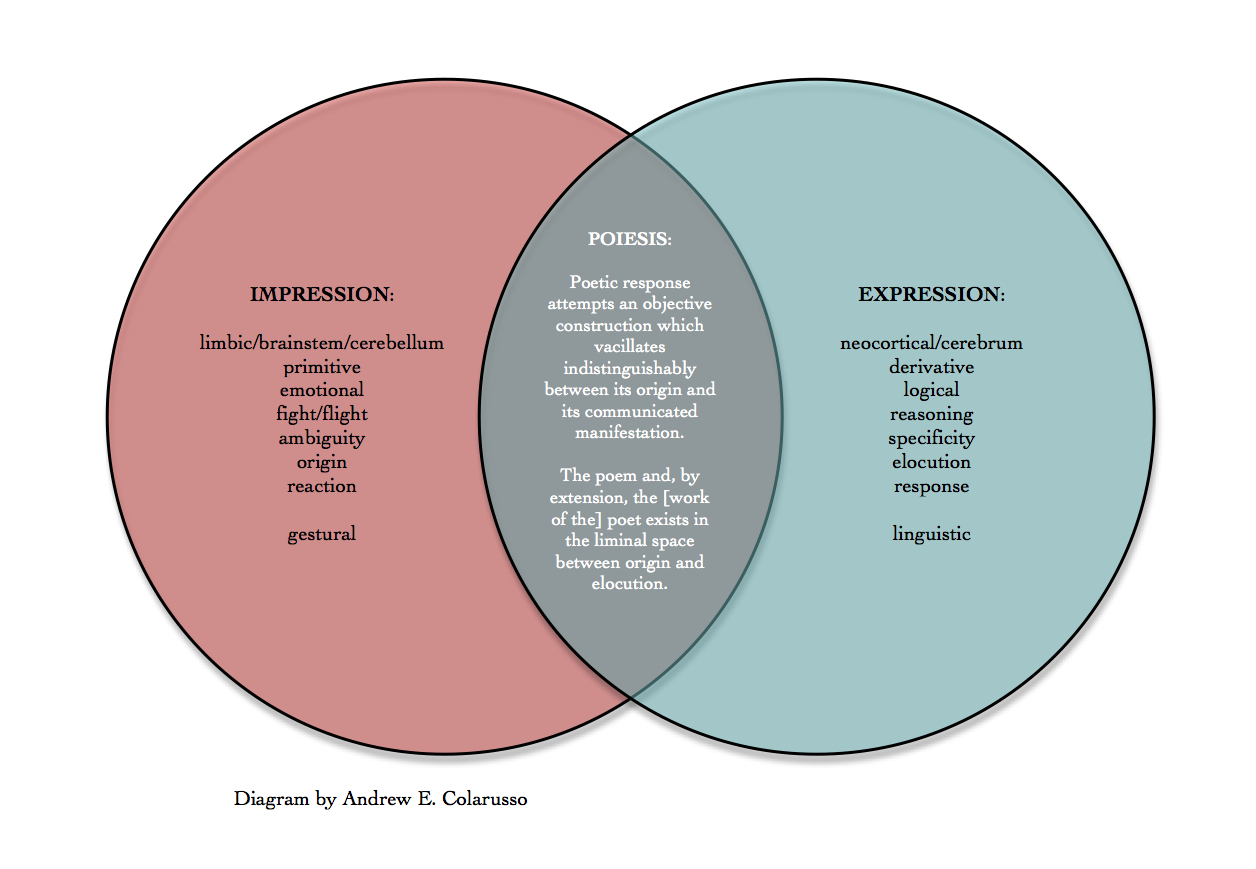
The poetic impulse is this transverse traversal of perceptive phenomenon. It begins with limbic impression which itself is ambiguous and wells from the most primitive portion of the human brain. These basal impressions are prompting. The poet is bound to the observation of her primal or basal nature. The poet is primitive and the work of the poet is this necessary transversal by which we as a collective whole come to understanding of being and origin. It is the impetus for invention and, by extension, intervention. “Anyone who experiences anything primitively also experiences in ideality the possibilities of the same thing and the possibility of the opposite. These possibilities are his legitimate literary property. His own personal actuality, however, is not.” (Kierkegaard) So it is that these impressions, or the impression, is always original without ever being new. It is common. It is familiar. It is commonly original. 
Celan’s poem, Todtnauberg (written 1 August, 1966; posthumously published 1970 in his collection 'Lichtzwang'), commemorating his now [in]famous meeting with Heidegger, is full of longing for a music beyond that of the flora which only bears witness without affirmation. Flora, for all of its beauty, is unable to apologize, to reconcile différance. Flora belongs to the sublimity which humanity finds itself arrested from. The Arnica and Eyebright (ger: Augentrost), our ingress into his poetic retelling, prefigures the cruelty of this sublime silence. The Arnica and Eyebright, the Orchis, which signifies the transubstantiation of the body of Celan’s non-nation (like Edelweiss in The Sound of Music), cannot say “You’ve suffered. Please come inside. Rest a while. Allow me to apologize. We shall suffer and survive together.”

V.
If the poetic impulse begins with impression, it then finds expression in neocortical synapses. Impression/feeling is given over to language and more complex processing by way of signs and signifiers so that the feeling may be apprehended and communicated to like of our species. Apprehension here does not, however, imply comprehension or even an arrest of feeling. You go on feeling. And feeling, being original, needs supplement. 
“His speaking and his producing are, in fact, born of silence. The ideal perfection of what he says and what he produces will correspond to his silence, and the supreme mark of that silence will be that the ideality contains the qualitatively opposite possibility.” Kierkegaard’s silence here is limbic in origin. It is primitive feeling which in its private ambiguity elicits basic linguistic, even poetic, returns. The difference here being the immediacy of reaction as opposed to premeditated poetic response.  Reaction is, by dint of its happening, carceral. Response is an opening toward reaction or like response (i.e. dialogue/ transmission/ manumission). Imbued in the poetic response is both the affirmative and its negative, engendering the sublime infinitude of possibility.
So this transversal begins with basal impression and attempts to become entirely potential in a calculus of language. But language, as a mode of expression, like light energy, travels as both wave and particle. “Sometimes…instead of becoming welded together, words loosen their intimate ties.” (Bachelard) So it is that these expressions, or the expression, shifts invariably toward newness without ever being original. It is invasive. It is self-conscious, self-reflexive, and asymptotically diminishing in pursuit of its origin. It is its own telos. 

VI.
This, from Lyotard's Differend, sojourns with us in dialectic thought ”…the unstable state and instant of language wherein something which must be able to be put into phrases cannot yet be… the human beings who thought they could use language as an instrument of communication, learn through the feeling of pain which accompanies silence (and of pleasure which accompanies the invention of a new idiom)". Basal impression (with its origin in primal impulse) as it is brought into shared space by external expression (that which is in a state of constant revision to better apprehend its limbic origins), has need and use for synthetic supplement. This is our recourse to poetry and parapoetic document. So long as we are defined by our finitude, poetry will fulfill its purpose as the mode by which we are and through which we become. 
Apart from its mediated graphing, poetry is a matter of coherent scope, of seeingThe poet is guiding (poiesis) a certain construction (toward object, parapoiesis) on ever-shifting terrain. As such the construction itself is uncertain and the terrain, the strictures which govern the object's making, certain to change. Because the terrain of language is unstable and its origins in basal need consistently present, the parapoetic object attempts a vacillation between its origin and its communicated manifestation—invention or intervention by way of the synthetic, of simulacra; which is then to say, sometimes only you know the purpose of the object you've created. And that, as a declaration of function, is enough. 

VII.
It is already made. The primacy of our object-oriented poiesis here displaced and contextualized as a remainder of physis, or the “…pure potential to produce and disappear in [the] production. This is nature’s ideality that the new art wants to materialize in its simplified forms: in the graphic tracing of a poem, the silence of a dialogue, a bursting surface, the movement of a statuette, or the floral decorations of a piece of furniture.” (Rancière). The poem and, by extension, the [work of the] poet exists in the liminal space between origin and elocution—has no express relationship to material (as would an artist), choosing instead to commence from and remain with the immaterial. 

Because poetry is nobody, poetry is constantly seeking its proper body. [Modernism declares that] poetry exists in perpetual desire of its form. Out of such thought, the parapoetic object is actualized in this transubstantiation (via poiesis) from the epistemological into the technological. How ideas become words, how desires are fixed to bodies. And once the poetic has become the parapoetic, once epistemology has become technology, the object achieves its own governance, performs the poet's labor autonomously, carries potential for resistance. 


The resultant parapoetic object is akin to the formation and/or discovery of an adequately absorbent black body. 

VIII. 
When the devil calls you to question, you are bound to respond/react

The witnessing Eyebright of Celan’s Todtnauberg, for example. The object seized upon vouchsafes security against a sort of violence which is endemic to life and living. Sometimes it becomes necessary to erect a dam in order to prevent flooding. Consider the erection of a bridge. The poetic object may function in this way. An elocution against impossibility.  

IX. 
Is it possible to bear witness for the sufferings and spectral ingestions of a black body—the life of the poem which actualizes being by vacillation between origin and elocution? When asked by Gerhart Baumann, a professor at the university of Freiburg, if he’d attend one of Celan’s readings, Heidegger responded:

“I’ve wanted to become acquainted with Paul Celan for a long time. He stands farthest in the forefront and holds himself back the most. I know all of his works, also of the serious crisis from which he managed to extricate himself as much as a person is able. You are correct in interpreting how helpful a reading here would be. July 24 would be the best date for me…It would also be healing to show P.C. the Black Forest. Recently I found a new volume of his poems advertised: Atemwende.” (1966)

It is clear, by most accounts, that Heidegger mounted a concerted effort to greet the poet with measures of hospitality. In fact, before Celan’s arrival, Heidegger called in a favor from a friend and book-dealer in Freiburg. Heidegger asked him if he’d contact other book vendors in the area and have them put Celan’s works on display. Accompanied by Baumann on a walking tour of Freiburg, Celan was pleasantly surprised to find his work “…on display in every major bookstore window. He had no idea, however, that Heidegger was responsible for these displays.” (Lyon) Also, by most acknowledged accounts, Celan’s mental health appeared to improve noticeably, if only for a brief time, following his visit with Heidegger. 

X.
It is physically impossible to perceive, to be presented with, every detail of the story, so to speak. But the poet attempts to ingest entirely and with serial conviction the world in which the story takes place. These worlds-to-be weigh on the poet—this potential within a calculus of meaning, whispered into your ear. 


5/31/2013

Edited 7/10/2015
Edited 2/23/2016

Saturday, June 29, 2013

Mise-en-abîme in Brian Evenson's "Windeye"


What appears to be, in Windeye, is not what is in actuality. The result, which feels distinctly Brian’s or maybe Rod Serling’s, is a very intimate and jarring dissonance—a ringing in the ear which one locates just outside of the ear. A disembodied whispering over the shoulder.

He presents the reader with a mode of Pararealism—a twice displaced article that bears only a trace of its origin. Like finding yourself, your reflection, cascading infinitely between two directly opposed mirrors. Mise en abîme.

His is the presentation of a language, a matrix of interconnected signifiers which consistently evades the logic of reality as we live it and know it. So, in this way, what Brian presents in no unreal terms locates itself outside of or beside common perception. He presents a wilderness, a thing, a moment, a myth, skewed and spectacular and endowed with a certain alien quality that projects a distorted reflection of the reader.

Brian read this story to a small audience at Brown University just before the collection debuted and it was really that first scene, that first fragment that caught my mind’s eye, so to speak.

As the younger sister explores opaquely the exterior space of the house, fitting her small hand under the shingles, the older brother frames her experience narratively, sensually directing her thrill while he himself is thrilled by her reaction. It’s an uncanny denuding.

Looking back on it, many years later, he often thought it had started with that, with her carefully working her fingers up under a shingle as he waited and watched to see if it would crack. That was one of his earliest memories of his sister, if not the earliest. 
His sister would turn around and smile, her hand gone to the knuckles, and say, “I feel something. What am I feeling?” And then he would ask questions. Is it smooth? he might ask. Does it feel rough? Scaly? Is it cold-blooded or warm-blooded? Does it feel red? Does it feel like its claws are in or out? Can you feel its eye move? He would keep on, watching the expression in her face change as she tried to make his words into a living, breathing thing, until it started to feel too real for her and, half giggling, half screaming, she whipped her hand free. (1)

Influenced as I am with the work of William Faulkner and The Sound and the Fury especially, I asked Brian if he’d intentionally drawn some sexual, incestuous subtext between the siblings in the opening scene of Windeye. Of course he shrugged it off gracefully and I then felt like a pervert.

His response gave me the impression that it was not intentional, at least not in artifice. And, after all, a magician never reveals his secrets.

Written in the third person past tense, we as readers are already acutely aware that what has not yet transpired in narrative, has already occurred in time. This is a retelling, a secondary source. This creates an initial valance of distance. The narrative first introduces the physical space of the home. We then encounter the brother and sister in the familiar territory of juvenilia which is also already the poetic space of the uncanny—as both Freud and Bachelard can attest. “The German word 'unheimlich' is obviously the opposite of 'heimlich' ['homely'], 'heimisch' ['native'] the opposite of what is familiar; and we are tempted to conclude that what is 'uncanny' is frightening precisely because it is not known and familiar.” (Freud) This interplay of interiority and exteriority, of experiencing an intimate space and then from the outside witnessing its temporality and finitude, is a common theme in the collection.

This is embodied in the interplay of the children. The relationship between the siblings in Windeye bears a universe of potential energy which finally crescendos in the little sister’s disappearance and the older brother’s subsequent lapse from normative reality.

Being not alive wasn’t like being dead, he felt: it was much, much worse. There were years too when he simply didn’t choose, when he saw her as both real and make-believe and sometimes neither of those things. But in the end what made him keep believing in her—despite the line of doctors that visited him as a child, despite the rift it made between him and his mother, despite years of forced treatment and various drugs that made him feel like his head had been filled with wet sand, despite years of having to pretend to be cured—was simply this: he was the only one who believed his sister was real. If he stopped believing, what hope would there be for her? (5)

Immediately after reading the story I wanted to trace the narrative arc from its origin in reality to its manifestation in fantasy and place a cogent reading on its oddity, a carceral interpretation of its final discourse with wind. “If he turned around, he would be wondering, would he find the wind’s strange, baleful eye staring at him?” (6)

The first, and maybe most important clue we get is the dedication, For my lost sister. These are without a doubt the first and last transparent words the author inscribes in the text (disbarring the acknowledgments). Although it's possible that the dedication too was in service of the story, but I doubt it (paranoia). The story Windeye revolves around the loss of a sister, which coincides with the author’s dedication, now making this, in my opinion, a highly personal narrative.

Biography is relevant to our understanding of this text in so far as what occupies the narrative is memory and perpetuity. If the ghostly, unexplainable disappearance of the story’s little sister coincides with the true loss by the author of a sister, then the link here is trauma—a trauma which is veiled and then mythologized so as to allow its presence, her presence, as memory, as story, to exist. Because if she never existed then, in some way, neither had he.  

And if the story is itself a way of remembering the presence of another (perhaps the author’s sister), then the trauma, the experience of trauma, finds its objective correlative (Eliot) in the figuration of the Windeye.

The Windeye (a portmanteau of Nordic origin from which we derive our English Window) itself is an artifact which wrestles with notions of opacity and our response to opacity—in this case a hubris of Gnostic satisfaction and pleasure which culminates in loss. The boy wants to know with certainty, with empirical evidence, what occupies the discrepancy between what he’s perceiving and what he recognizes logically as truth or reality.

That is:

There’s a window visible on the outside which has no discernable presence on the inside. The boy is looking at an object which presents as its function and general purpose the ability to see through it, but this so called Windeye (not window) resists, and insists on its alterity—a window which projects outward, like the gaze of an eye, and captures/holds/suspends what it beholds. The uncanny here, again reminiscent of Freud and his fascination with E. T. A. Hoffman’s The Sandman, replicates itself in uncertainty and anxiety. And the narrative concludes thus.

And he would set about describing it. Does it feel red? Does it feel warm-blooded or cold? Is it round? Is it smooth like glass? All the while, he knew, he would be thinking not about what he was saying but about the wind at his back…

Chances were that he’d be stuck with the life he was living now, just as it was, until the day when he was either dead or not living himself. (6)

This final sentence in its deceptive simplicity belies the character’s abyssal relation to time. It is an interesting example of paraprosdokian—from the Greek para (παρά) meaning beside, outside of, or against, and prosdokia (προσδοκία) meaning expectation. Consumed in what one may interpret as survivor’s guilt, the boy, now an old man, replays in his mind the young thrill of their experience as children. He has to remember, revisit, reinscribe their empirical instance because, “…what hope would there be for her [to live on]?” He admits his secret intention to continue visiting this memory until he is dead or not living. Hearkening back to his revelation that being not alive wasn’t like being dead…it was much, much worse. That one could be both dead and not-living, like Schrödinger’s cat, is yet another suspension which implies that he alone is responsible for keeping his sister from death, though she is not living. The conundrum, inherent in his mission of remembering, traps him tragically in a circular ruin (Borges).

The ruin of this final sentence falls farther, deeper, into anacoluthic distortion. Chances were that he’d be stuck with the life he was living now, just as it was… There is a fracture, a hanging conditional, a past subjunctive perhaps—already narratively couched in the past, his present is contingent upon what was and cannot be removed from this paradigm without inhabiting what is worse than death. Abyssal time.

In a way, Windeye is a sort of eerie reconfiguration of the Pandora’s box myth. What is ultimately lost is innocence and candor, the innocence and candor that comes with youth, with opacity. What remains is the injunction of narrative, belief, and hope.


—Presented at Université Rennes 2, May 21, 2015 
Colloque sur l'oeuvre de Brian Evenson

Saturday, October 6, 2012

Fool's Gold: Abstract Economy in Miyazaki's Spirited Away


Miyazaki's films, particularly those produced by Studio Ghibli, have for a long time been a source of joy and inspiration for me. And I do not use joy lightly. Joy, as a facet of the human experience, is distinct from happiness in that Joy is not circumstantial, per se. Happiness can be chemically replicated. Endorphins, dopamine, tryptophan and oxytocin are just a few of the naturally occurring hormones and neurotransmitters the body produces that elicit feelings of happiness, well-being, comfort and love. In essence, happiness can (and has been) produced for general consumption. Joy, on the other hand, is innate/internal and does not necessarily have a mode of expression or replication. Joy is spiritual. Or, more concretely, Joy is the positive manifestation of a healthy relationship with one's memory. 

It is in this sense that I relate to Miyazaki's films. Of his Studio Ghibli films, I think most often of "Spirited Away". I remember thinking that the music moved so elegantly through and between each scene. It was my first Miyazaki film, and from outset to conclusion I was rapt in the Bizet-esque* (cf. Nietzsche's Der Fall Wagner) presentation of the real beside the spiritual. The color palette was so stimulating and vibrant, without being garish (cf. Spongebob) and the various depictions of light, natural and otherwise, were hauntingly beautiful (cf. Picasso's Le Moulin de la Galette). But what has truly captured my imagination, since I first saw the film several years ago, is the uniquely accessible semiotic woven through the fibers of the film's narrative.

"Spirited Away" is a Derridean archive--a discursive matrix of representations. As night begins to fall on the mysterious netherworld and the spirits begin to articulate their forms, Miyazaki calls for the viewer's embarkation.


At this point, always, I begin to feel as though I'm tangibly reacquainted with the curious mystery of youth, my youth, and its tender evaporation. It's not necessarily a negotiation/hermeneutic of life and death. It's not nostalgia per se. I think it's a joyful embarkation on the ferry of a master storyteller--the excitation of suspending reality in favor of the imaginary that I equate with my young mind (or the young part of my mind) It is a new world, not of my own imagination, but like the experience of deja vu, Miyazaki's imagined world bears a strange resemblance to my own. This elicits desire--a desire to explore and discover his world and its spirits. Returning to this notion of the film as archive, my recent preoccupation has been with the quiet, creeping wraith called No-Face.


No-Face is a sort of ethereal creature, more so than the other spirits in that he has no full form, wears no expression, and serves no knowable purpose--hence No-Face. He is masked at all times and from the start of our protagonist's (Chihiro/Sen) journey across the bridge into the spirit world, No-Face, who seems to see through her temporary invisibility, is aware of her presence. Shortly after settling into her new world, Chihiro (who is now called Sen) encounters for the first time the foreboding presence of No-Face on the bridge. It isn't until later that evening, when Sen allows No-Face to enter the bathhouse, that No-Face presents his unique ability. He can materialize gold in the palm of his ghostly hands. He also intervenes on her behalf during her first bath task, bringing her an excess of bath tokens (which are required to initiate specific bath water combinations for soiled spirits). No-Face's character, for the majority of the film, operates within this unusual economy. His multifarious lack--lack of identity, lack of purpose, lack of voice--is channeled into his excessive desire to create and then give, a sort of philanthropic impulse with questionable intention. His silence, for much of the film (until he begins eating other characters), further underscores No-Face's questionable character.


Sen, who he's taken a liking too, often refuses his excessive gifts, finding that they serve her no purpose. Feeling rebuffed by her, No-Face begins to produce tremendous quantities of gold, drawing the greedy attentions of the bath house workers who try to appease his unseemly appetite. He begins to consume ravenously and with no regard for the lives of the bathhouse inhabitants. He is transformed from a quiet figure of longing, into a monster of consumption. This is a major thematic thread in the film. Each of the characters in the film, with the exception of our protagonist, is at some point tempted and transformed (or nearly transformed) by the anti-promise of material wealth and sensual satisfaction. In this sense, No-Face is the embodiment of the film's central preoccupation. 

How then do we, can we read No-Face? The deceptively generous wraith is, in many ways, a Jungian dream archetype that we've all encountered--the joyless manifestation of an unrequited desire. No-Face is a sort of haunting or hauntedness. Have you ever been courted by someone whose desire, you both knew, was not in the right place? Rational communication breaks down (between self and self [denial], between self and other) and the gesture of generosity, with the intention of possessing the object of desire, becomes a vacuum of consumption where notions of wholeness are lost, collapsed. No-Face, we begin to realize, is sick. Of course, Sen's solution to his illness in the film works through a great deal of magic. Perhaps it takes a little magic to fill the no-face void in each of us--the void that haunts us in the middle of the night and motivates us to move, to create, to consume or be consumed. And perhaps it takes some faith to know that this void is not necessarily a malign force operating within the self. 

...

from The Perforator God
by Ariana Reines
(Mercury, Fence Books, 2011)

...

A silver corsair

In a violet distance

That I am capable of imagining

Inside a world

In which the cashew-colored sky

Emits a musk

Of snow

Is the zone in which

I will lay down what's most harassed in me

And make it die.

...