Showing posts with label Critique. Show all posts

Friday, March 4, 2016

Follow the Mannequins

by Eduardo Robles


Spring 2016

On the first day of the graduate seminar Museum Interpretation Practices, offered by the RISD Museum in partnership with the John Nicholas Brown Center for Public Humanities, students were assigned the task of describing, deducing, and speculating on an object’s values and beliefs, and our ideas about its time, without the aid of exhibit labels. I chose Andy Warhol’s Race Riot, 1964.

In undertaking this assignment, I followed T.J. Clark’s style of experimental art writing in The Sight of Death, where he chronicles daily visits to the Getty to better understand his shifting perspectives on his object of study, and gathers a storehouse of experiences before synthesizing an interpretation. Clark’s interpretive method favors the hyper-local, quotidian, and durational. If Foucault has it that power operates at all levels of society, Clark’s criticism answers with a politics of everyday life. Combining his diaristic style with methods in material culture, artifact studies, and critical theory, my interpretation of Race Riot, 1964 took shape as the following:

Friday, July 10, 2015

De Merveilleux Espoirs: On the work of Johanna Rocard


“In the quest for equality, black folks have tried everything. We’ve begged, revolted, entertained, intermarried, and are still treated like shit. Nothing works, so why suffer the slow deaths of toxic addiction and the American work ethic when the immediate gratification of suicide awaits? In glorious defiance of the survival instinct, Negroes stream into Hillside, California, like lemmings. Every day they wishfully look heavenward, peering into the California smog for a metallic gray atomic dot that will gradually expand until it explodes some one thousand feet over our natural and processed heads. It will be the Emancipation Disintegration. Lunch counters, bus seats, and executive washrooms be damned; our mass suicide will be the ultimate sit-in.”[i]

In this darkly comedic, decidedly pessimistic excerpt from Paul Beattys The White Boy Shuffle the idea of black agency is radicalized (has been radicalized) sometime after the 90s L.A. Riots, as a movement of mass suicide – a relational gesture in which the black body (re)commits itself to its own agency (see: Seppuku) in the face of anti-black racism and hatred. Beattys 1996 debut novel walks out the idea and possibility of radical liberation in the face of oppression the seeds of which, one might say, were planted in the popular imagination with the advent of the American Civil Rights Movement. The White Boy Shuffle imaginatively, fantastically, and fatally extends the provenance of 20th century black liberation into the 21st century an idea marched into the present. That is: if black bodies are consistently, reluctantly, inadvertently, and violently imbricated in the schemata of American capital, liberations only recourse is to deprive the system of its corporal capital.

I woke up this morning wondering: are we living through a suicidal moment? And are we, the living, tragically subsumed in the machinations of a system which tallies each slow death?

Friday, January 23, 2015

The Ethics of Losing pt. 2

The Ethics of Losing pt. 2
by Ampson Hagan
Peace Corps Volunteer
Health Sector
Cameroon 2013-2015

read pt. 1 here


You were supposed to succeed, people depended on you to do so, and you whiffed. I’m not talking about some moral failure, one that reflects a character flaw or temporary lapse in judgment; that failure is apart from the simplistic, yet absolute, binary of win/lose. When the stakes are higher, and conclusions render a success/failure decision, it’s no longer akin to a game. Losing an MLB game in July doesn’t perpetuate a crippling disease or result in women dying from preventable hemorrhaging in some rural Cameroonian clinic. It’s just not that serious.

I’m not an either/or type of person despite the fact that the dichotomization of all aspects of modern society has unceasingly tried to convert me. I think that the human tendency to reduce everything to quantifiable, ranked categories, obscures our wonderful ability to interpret the seemingly black and white with incredible nuance and sensibility. But yeah, some things really are just black and white, good and bad, 1 and 0. Winning and losing, and sometimes, success and failure, are easy to understand. But the failure as a functional state of existence, a thing, is not so innocuous and insignificant.

Wednesday, July 30, 2014

A New Center for Black History in the 21st Century

The Black Cultural Archive's new Heritage Center in Windrush Square, Brixton (London, UK)
photo by Edmund Sumner
by Andrew E. Colarusso

Brixton, in the south London borough of Lambeth, is now home to the Black Cultural Archive's Heritage Center. Opened last week, the Heritage Centre is located in Windrush Square, the arrival site of the first major Afro-Caribbean wave of immigrants to the United Kingdom. The Windrush Empire made its voyage from Jamaica to Brixton, London in 1948 carrying 492 passengers (one stowaway) and the rest is history. Brixton today carries this cultural legacy with a thriving West Indian and African community. So what is this new Heritage Center and what does it mean?

Sunday, July 27, 2014

Form Submission; Form Rejection

by Andrew E. Colarusso

Many among the thousands of us who write poetry, or assume the title of poet--in fact, all of us who have considered the possibility of an original creation being actualized in this world have also contended with rejection. It's natural to every process. We are continually engaging and negotiating the corners of our lives with varying degrees of success. But for poets (and writers in general) the rejections seem to come several at a time and consistently. This is part and parcel of the job. 

A poet asserts an idea or an aesthetic while adapting process to reach an objective aim. It's a constant push and pull, swinging back and forth between a necessary obstinance and amenability. And the poet herself is subject to much discussion and classification, especially with regard to creative output and aesthetic. i.e He's formal and lyrical; she's a feminist poet; they make conceptual pieces; we strictly write for the page. I'm doing my best not to place poets within an objectifying binary (hermetic/populist, tradition/vanguard, demotic/hieratic) Poets universally engage process, and a part of that process is dealing with the consequences of our submissions, dealing with the ways our work is received. We all get rejections...

Tuesday, July 8, 2014

[Final] Thoughts on Kara Walker's Sphinx: A Subtlety

by Andrew E. Colarusso

I never went back to see the Sphinx, to see whether it was left to melt even slightly over the styrofoam beneath it. We are each of us, whether we realize it or not, participants in a kind of daily pornography which is often more difficult to avoid than submit to. It's everywhere...

Tuesday, June 3, 2014

Americans, Boko Haram & Message Control

Ampson Hagan, MPH
Peace Corps Volunteer
Health Sector
Cameroon 2013-2015


The tension is a palpable drum beat in the air. How quickly the calm and quotidian life in village can warp into a roiling wave of danger and anxiety. Somewhere in between those extremes, the mere knowledge of the existence of possible doom has created a highly fragile and volatile resting state. Boko Haram is as much a danger as it is an intractable cancer, with remission being simply the lull in between terroristic episodes. Boko Haram already has a real effect on my safety and well-being. Being so close to the Cameroonian-Nigerian border, this Boko Haram crisis is a credible threat that may materialize into a dangerous episode. My biggest fear is being forced to move. Moving in the States is a nightmare, even with all the moving campaigns and packing materials and the often taken for granted ability to drive myself. Here in Cameroon, simple travel is an adventure that often borders on reckless personal endangerment. Having to move would be harrowing.

Saturday, June 29, 2013

Mise-en-abîme in Brian Evenson's "Windeye"


What appears to be, in Windeye, is not what is in actuality. The result, which feels distinctly Brian’s or maybe Rod Serling’s, is a very intimate and jarring dissonance—a ringing in the ear which one locates just outside of the ear. A disembodied whispering over the shoulder.

He presents the reader with a mode of Pararealism—a twice displaced article that bears only a trace of its origin. Like finding yourself, your reflection, cascading infinitely between two directly opposed mirrors. Mise en abîme.

His is the presentation of a language, a matrix of interconnected signifiers which consistently evades the logic of reality as we live it and know it. So, in this way, what Brian presents in no unreal terms locates itself outside of or beside common perception. He presents a wilderness, a thing, a moment, a myth, skewed and spectacular and endowed with a certain alien quality that projects a distorted reflection of the reader.

Brian read this story to a small audience at Brown University just before the collection debuted and it was really that first scene, that first fragment that caught my mind’s eye, so to speak.

As the younger sister explores opaquely the exterior space of the house, fitting her small hand under the shingles, the older brother frames her experience narratively, sensually directing her thrill while he himself is thrilled by her reaction. It’s an uncanny denuding.

Looking back on it, many years later, he often thought it had started with that, with her carefully working her fingers up under a shingle as he waited and watched to see if it would crack. That was one of his earliest memories of his sister, if not the earliest. 
His sister would turn around and smile, her hand gone to the knuckles, and say, “I feel something. What am I feeling?” And then he would ask questions. Is it smooth? he might ask. Does it feel rough? Scaly? Is it cold-blooded or warm-blooded? Does it feel red? Does it feel like its claws are in or out? Can you feel its eye move? He would keep on, watching the expression in her face change as she tried to make his words into a living, breathing thing, until it started to feel too real for her and, half giggling, half screaming, she whipped her hand free. (1)

Influenced as I am with the work of William Faulkner and The Sound and the Fury especially, I asked Brian if he’d intentionally drawn some sexual, incestuous subtext between the siblings in the opening scene of Windeye. Of course he shrugged it off gracefully and I then felt like a pervert.

His response gave me the impression that it was not intentional, at least not in artifice. And, after all, a magician never reveals his secrets.

Written in the third person past tense, we as readers are already acutely aware that what has not yet transpired in narrative, has already occurred in time. This is a retelling, a secondary source. This creates an initial valance of distance. The narrative first introduces the physical space of the home. We then encounter the brother and sister in the familiar territory of juvenilia which is also already the poetic space of the uncanny—as both Freud and Bachelard can attest. “The German word 'unheimlich' is obviously the opposite of 'heimlich' ['homely'], 'heimisch' ['native'] the opposite of what is familiar; and we are tempted to conclude that what is 'uncanny' is frightening precisely because it is not known and familiar.” (Freud) This interplay of interiority and exteriority, of experiencing an intimate space and then from the outside witnessing its temporality and finitude, is a common theme in the collection.

This is embodied in the interplay of the children. The relationship between the siblings in Windeye bears a universe of potential energy which finally crescendos in the little sister’s disappearance and the older brother’s subsequent lapse from normative reality.

Being not alive wasn’t like being dead, he felt: it was much, much worse. There were years too when he simply didn’t choose, when he saw her as both real and make-believe and sometimes neither of those things. But in the end what made him keep believing in her—despite the line of doctors that visited him as a child, despite the rift it made between him and his mother, despite years of forced treatment and various drugs that made him feel like his head had been filled with wet sand, despite years of having to pretend to be cured—was simply this: he was the only one who believed his sister was real. If he stopped believing, what hope would there be for her? (5)

Immediately after reading the story I wanted to trace the narrative arc from its origin in reality to its manifestation in fantasy and place a cogent reading on its oddity, a carceral interpretation of its final discourse with wind. “If he turned around, he would be wondering, would he find the wind’s strange, baleful eye staring at him?” (6)

The first, and maybe most important clue we get is the dedication, For my lost sister. These are without a doubt the first and last transparent words the author inscribes in the text (disbarring the acknowledgments). Although it's possible that the dedication too was in service of the story, but I doubt it (paranoia). The story Windeye revolves around the loss of a sister, which coincides with the author’s dedication, now making this, in my opinion, a highly personal narrative.

Biography is relevant to our understanding of this text in so far as what occupies the narrative is memory and perpetuity. If the ghostly, unexplainable disappearance of the story’s little sister coincides with the true loss by the author of a sister, then the link here is trauma—a trauma which is veiled and then mythologized so as to allow its presence, her presence, as memory, as story, to exist. Because if she never existed then, in some way, neither had he.  

And if the story is itself a way of remembering the presence of another (perhaps the author’s sister), then the trauma, the experience of trauma, finds its objective correlative (Eliot) in the figuration of the Windeye.

The Windeye (a portmanteau of Nordic origin from which we derive our English Window) itself is an artifact which wrestles with notions of opacity and our response to opacity—in this case a hubris of Gnostic satisfaction and pleasure which culminates in loss. The boy wants to know with certainty, with empirical evidence, what occupies the discrepancy between what he’s perceiving and what he recognizes logically as truth or reality.

That is:

There’s a window visible on the outside which has no discernable presence on the inside. The boy is looking at an object which presents as its function and general purpose the ability to see through it, but this so called Windeye (not window) resists, and insists on its alterity—a window which projects outward, like the gaze of an eye, and captures/holds/suspends what it beholds. The uncanny here, again reminiscent of Freud and his fascination with E. T. A. Hoffman’s The Sandman, replicates itself in uncertainty and anxiety. And the narrative concludes thus.

And he would set about describing it. Does it feel red? Does it feel warm-blooded or cold? Is it round? Is it smooth like glass? All the while, he knew, he would be thinking not about what he was saying but about the wind at his back…

Chances were that he’d be stuck with the life he was living now, just as it was, until the day when he was either dead or not living himself. (6)

This final sentence in its deceptive simplicity belies the character’s abyssal relation to time. It is an interesting example of paraprosdokian—from the Greek para (παρά) meaning beside, outside of, or against, and prosdokia (προσδοκία) meaning expectation. Consumed in what one may interpret as survivor’s guilt, the boy, now an old man, replays in his mind the young thrill of their experience as children. He has to remember, revisit, reinscribe their empirical instance because, “…what hope would there be for her [to live on]?” He admits his secret intention to continue visiting this memory until he is dead or not living. Hearkening back to his revelation that being not alive wasn’t like being dead…it was much, much worse. That one could be both dead and not-living, like Schrödinger’s cat, is yet another suspension which implies that he alone is responsible for keeping his sister from death, though she is not living. The conundrum, inherent in his mission of remembering, traps him tragically in a circular ruin (Borges).

The ruin of this final sentence falls farther, deeper, into anacoluthic distortion. Chances were that he’d be stuck with the life he was living now, just as it was… There is a fracture, a hanging conditional, a past subjunctive perhaps—already narratively couched in the past, his present is contingent upon what was and cannot be removed from this paradigm without inhabiting what is worse than death. Abyssal time.

In a way, Windeye is a sort of eerie reconfiguration of the Pandora’s box myth. What is ultimately lost is innocence and candor, the innocence and candor that comes with youth, with opacity. What remains is the injunction of narrative, belief, and hope.


—Presented at Université Rennes 2, May 21, 2015 
Colloque sur l'oeuvre de Brian Evenson

Monday, July 25, 2011

The Syncopated Sonnet

Tyehimba Jess

I've long admired this Poet's work. I also must admit that I am disappointed with the syncopated sonnet. I've heard much buzz about these syncopated sonnets and was hoping to hear the voice of Tyehimba himself--less of historical portraiture. But the fact of his voice, and my voice--the darkling first person plural voice--is magnificently present and potent. A genius of linguistic dexterity and human understanding undergirds the construction of such form. There is a strange and estranging beauty to the very final moments of this video when the collective face of the audience is revealed--a swath of folk primarily light in complexion. And there, on the stage, Tyehimba stands reciting his multiply woven pygopagus monstrosity, mirroring the traveling performance of the sister(s). A wonderful tribute to the McKoy Sisters and a very important new work of invention--if a bit green-black in the voice. 

--Andrew E. Colarusso

Monday, June 27, 2011

Christian Marclay’s The Clock


By Katie Smither

Christian Marclay’s most recent work of appropriated, remixed material won Germany the Venice Biennale’s Golden Lion at the beginning of this month.  Though the work has been making waves in the contemporary art circles for nearly a year now, this recent attention served to cement The Clock in a place of serious consideration, some going so far as to call it the work of our time (news articles and mega-curator’s Facebook pages alike).

The work, a video installation or “film”, is a 24-hour loop composed of selected film scenes containing clocks and representations of passing, measured time.  A wide array of film is represented within these edited sequences, which are then arranged according to the time depicted in the narrative of the clip so the hour and minute told in one piece of film picks up in the next.  The Clock is played in unison with the local time of the city screening the piece, and as the title describes, functions like a clock as it runs continuously.  From what I’ve heard, no venue has screwed up a viewing yet and The Clock will remain accurate to what ticks on your iPhone.

It is, without a doubt, a marvel of craft and film theory and spectacle.  The piece has no beginning or end.  It is equal parts essay, love poem, and critique of our relationship to film, reality, and time.  Word on the street suggests it’s even genuinely enjoyable to watch, waiting for familiar scenes to unfold and break into new ones. 

I’m most curious about how The Clock could or could not be considered filmic or narrative.  It certainly deals with it.  Embracing created narrative, breaking that narrative, relying on the memory of a storyline, creating another through the pieces, all while avoiding resolution, as the specifics of each clip don’t inform the video as a whole.  Narrative seems to be at the mercy of the video’s structure.  As it turns, The Clock attempts to objectively measure time, rubbing shoulders with a clinical process seemingly non-narrative and more procedure.  However, through appropriation, the clinical gains content, each individual viewer bringing unique association and personal history to the series of scenes shown.  These histories speak to one another through juxtaposition and Marclay’s editing decisions, but remain underneath the system of passing time dictating their duration, placement, and purpose.   The reason and meaning of The Clock is in its operation and function.  Perhaps more than any other film or video before it, Marclay’s piece relies on the line between real and fictive time to drive it forward, hinging on the viewer, the object viewed, and the space of watching and waiting.  The video’s significance is not within its content, but context and consumption.  Perhaps more than any film or video before it, The Clock begins to materialize problems of real or spatial time in film.  The viewer sitting in the gallery at 4 AM watching 4 AM is the subject and conflict of the video, the time zone and location of the screen on earth are the setting.   Watching The Clock in passing time and particular space is what The Clock is about.  Where is the story located?  Can the function or consumption of an artwork be its narrative?  Is this a film/video or conceptual gesture?
-Katie Smither

Sunday, June 12, 2011

Venice Biennale 2010: Allora y Calzadilla

Track and Field 2010; Allora y Calzadilla

By Katie Smither

Despite sending half the summer Olympic team to the Venice Biennale, the USofA did not walk away with best in show.  That award, the Golden Lion, went to Germany’s pavilion: Christian Marclay for “The Clock,” which we can hash out another day... But first we must talk about US (U.S.), because we did cause a stir, in great American fashion. The artists representing America for 2011?  Jennifer Allora and Guillermo Calzadilla: a collaborative couple whose body of work often touches on issues of national identity, politics, juxtaposition of objects and their meanings, and the performative gesture…to oversimplify.  Preluding their work for the Biennale, you may have seen Stop, Repair, Prepare at MoMA last winter. Their nomination came as a surprise this year for a number of reasons.  The duo is the first plural entity chosen to represent the United States, they are not a powerhouse symbol of American art like past representatives have been (Bruce Nauman, Golden Lion 2009), nor do they hail from the 50 United States, but rather live and work in Puerto Rico.  Allora, born in Pennsylvania, and Calzadilla, born in Cuba, currently making Puerto Rico their home and office, represent a different kind of American artist at the Biennale.  One not yet canonized, influenced by several cultural facets of “American”, and critically, politically, aggressively activist.  It needs to be said, this risky and progressive choice of artist for the US pavilion holds its own value before we even see the work.
Watch the full episode. See more PBS NewsHour.

Body in Flight (American) and Body in Flight (Delta)

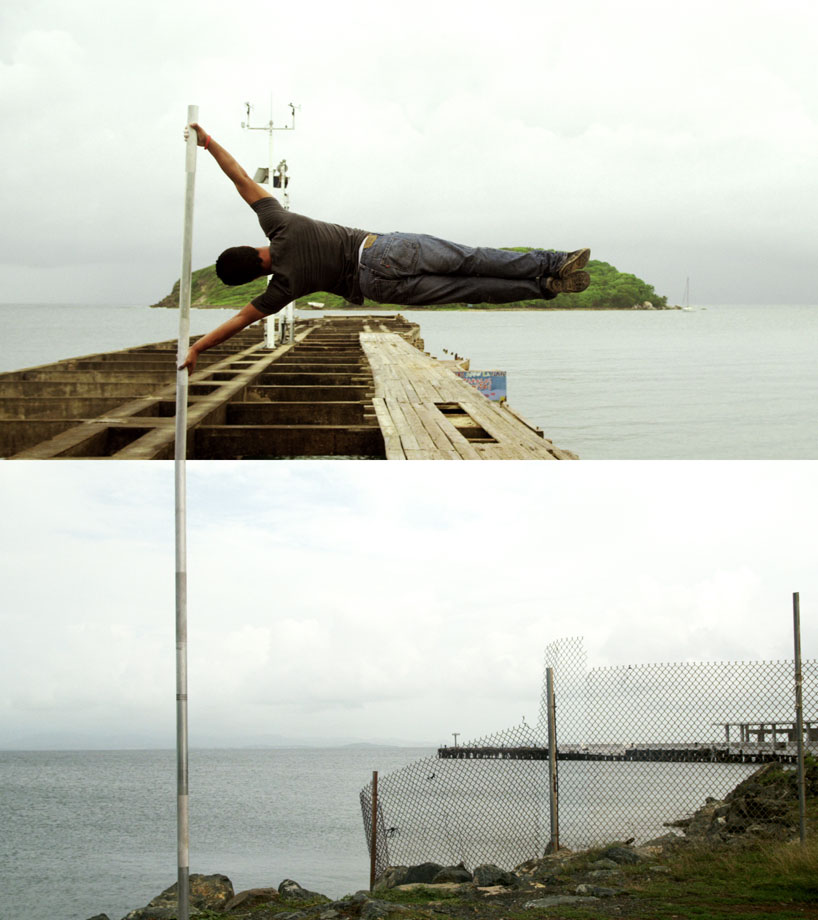
For the Biennale, Allora and Calzadilla present Gloria, a five piece exhibition deeply concerned with what it means to be American today, specifically focusing on competition, condition, and display.  The upturned tank of Track and Field immediately imposes upon the entire Biennale with its size and incessant racket.  A figure poised atop a pedestal, US Olympians alternate running in place.  Indoors, two gymnasts perform choreographed routines upon sculptural reproductions of first-class airline seats.  In this, Body in Flight, the theatrical quality of the gymnastic routine is dislocated to the confines of a small gallery room where dramatic display becomes excessive and uncomfortable, USA emblazoning across uniforms, while still maintaining the allure and beauty of accomplishment and skill.  Algorithm is a custom-fabricated organ fashioned to play in direct response to a built-in ATM machine used by visitors to the pavilion.  It sings and glorifies a unique composition for each individual transaction.  Armed Freedom Lying on a Sunbed is exactly that, and painfully literal. This is when it gets apparent that they were trying to do a lot in a short amount of time. The exhibition wraps up with Half Mast/ Full Mast, a video continuing the collaborators’ series on the Puerto Rican island of Vieques, which the US Navy used as a military base and bombing practice range after relocating citizens.  Through a fractured frame, the video shows a man lifting himself horizontally in place of a national flag over different cites relevant to the island’s historical struggle for freedom and rights.

On the whole, I have mixed feelings about Gloria.  I respect what Allora and Calzadilla are trying to do.  These pieces are loud and aggressive, and some things they do well.  The absurdity is often effective, creating a disturbing middle ground between horror and humor.  Using the belligerent and imposing nature of US policymaking and military strategy as a method for presenting artworks creates a painfully tangible affect, holding a mirror up to the beast, and they function as critique that way.  But is it dangerous for an artist to adopt the methodology of the system they critique as a means to build metaphor?  My concern is that in the overstatement and imposition that mirrors American systems, the work itself, perhaps its poetry, becomes cold, calculated, overly didactic, and hyper-aware of its diplomacy, its many ways of relating to the international viewer.  Surely art-making requires its distinct way of functioning to function well.

I also wonder if there are epic contradictions in the cost required to produce these grand, perfect objects of “American art” that then critique consumerism with an ATM, indulgence and narcissism with a tanning-bed, and capitalist imperialism with a tank.  It’s a tank!  Do you know how much that cost to get to Venice?  Only the USA would do that…right?  So in mimicking, do Allora and Calzadilla’s works come close to committing the crimes they condemn?  Does the work lose power associated with the artists’ individual methodologies by adopting another system’s?  Or is the artistic gesture and the final product worth that sacrifice?
-Katie Smither

Wednesday, June 8, 2011

The Thin Man and Noir

Noir has been on my mind lately. Naturally, I turned to Dashiell Hammett when I got the urge for some mystery – picking up The Thin Man from a used book stand near Washington Square Park. Actually, the truth is I saw it and it was cheap and I liked the cover – of course, having read The Maltese Falcon a few years ago I was already familiar with his work, so I gave it a try.
I couldn’t put it down.
What fascinates me most about the noir genre, specifically those books focusing on crimes in the 20s and 30s, is the way in which the mind and clever conversation play the most important role in committing and solving a crime. The action usually occurs out of the scene, and the characters simply talk about it later, most often in the most hilarious ways (I was surprised by the comedy in fact, sometimes laughing out loud.) Some characters are never seen, communicating solely by letter or telephone.
It takes place in an era of technology before ours, when things were advanced but not enough to scrape DNA from hair samples and contact anyone from anywhere by a cell phone, when you sent harrowing letters by telegraph and the elevator boy walked you to someone’s room when you went to visit them (usually so he could become a witness for who has been entering which apartments). I read twenty pages out of a David Baldacci novel once and decided to stop on the grounds that the characters and the settings felt empty. I felt just as bored as the detective must have, waiting around for his DNA samples to be tested and his video surveillance to be analyzed. I don’t believe that crime novels now (and taking place in a contemporary setting) must be boring on account of the technology, and if someone who sees this knows a good one, I’d be very interested, but the advancement of technology certainly seems like a hindrance, especially when it comes to character development. I am not saying it can’t be done, but it seems more difficult. Characters don’t have to be particularly witty or clever or entertaining to commit crimes, they simply have to be sneaky, which is a trait inherent in all of Dashiell Hammett’s characters, guilty or not. This is a large reason for the elevation of language in Hammett’s stories, the need for each character to be extra clever, and for there to be an immediate divide between those who can speak well, and those who cannot.
Noir is a genre that becomes all about the characters – the plot lines remain generally the same; a lot of money is stolen, someone is killed, somewhere two people fall in love – what shines is the creation of characters, their differentiation through language, and the way that the author tells you straight to your face who did it as many times as he possibly can while still managing to keep you guessing until the end. Of course the not knowing is the best part – and still the picture I have of Mimi in my head makes me squirm, and her shady children certainly have something to hide. The mafia man Morelli in the speakeasy probably lied about everything he said, and why did the bar owner Studsy beat the hell

out of the pale man? Will we ever really know who murdered Julia Wolf? But I am intrigued by the title – The Thin Man…I won’t say too much because I don’t want to give it away, but the title is exceptionally clever and the more I consider it the more I find it to be the perfect title. The word “thin” can mean so many things beyond weight, and if you consider the various goals of the various characters in the novel, you will begin to understand what I mean.
What does it take to make new noir? I seem to only be able to turn to movies, which may not be completely considered noir but have the feel – like The Machinist, or Memento, where the solution that puts the focus back on the mind is taken care of by a character not being completely sane; or The Silence of the Lambs, where the crime solving is done precisely in the way it is done in Hammett, by clever dialogue between clever characters. (I have never read the books the movie is based off of, maybe it is worth a try.) There are twenty other films I could name, I am sure, (Fargo, Taxi Driver, Blood Simple, Pulp Fiction, Blade Runner, etc.) but I guess the question is still left at what it takes to write it, what must be present, and what must not be present – or what must be present and yet remain as hidden as possible to the reader. As always, I am very interested in the structure of things, and the only problem with noir is, the point is to make the structure utterly confusing. All the more interesting for investigation, I say.
--Eric Adamson

Friday, June 3, 2011

Paris is Burning

It is vexxing, grotesque, erotic and sensual, seductive, liberating, alien--all of the hot-button words we have, at present, come to associate with beauty.

You want me to say who I am and all that?! (demure)
Paris is Burning (1990) if you haven't seen it, is a quintessential New York film--a glimpse into what anthropologists will refer to as the metropolitan male sexual paradigm of the post-modern era. The film is charming, humorous, enlightening, gritty--certainly disturbing for the uninitiated. The director in you will love Jennie Livingston's and Paul Gibson's set up. The poet in you regards this as one of the most quotable films of all-time. The cast of characters--and they are characters....

The good Queens of Paris's Ball are the mothers of a generation of self-styled legends. The House of Labeija. The House of Ninja. The House of Xtravaganza. These are the old crews--ala The Warriors but a little less tame than any of the post-punk gangs of that fictional New York City. What is absolutely striking about the film is not the surface idea of a cast of Live Queens--as may be the case perhaps for the uninitiated--it is the way the film and its characters discuss candidly the issues of late 80's New York and America. Press play--the film is immediately sincere, but in no naive sense of the word. Sincere--not quite cynical, certainly hopeful--definitely unshy.

Perhaps my favorite scenes are of the two Latino boys out on the street at 2 am--just after the introduction of Venus Xtravaganza. One is slighter and more fayish (15) with his arm draped arm the more boyish (13--sipping a Sunkist). They are both asked what they're doing out so late and--of course--where's your mother?! The fayish boy responds "I don't have a mother." The director chooses then to have Pepper's voice, over the scene of these two boys, lamenting the sad past that breeds many young legends and Queens.

Yet another question present here is the glorification of whiteness--socio-economic whiteness--let's be clear. We must consider the arguments of Bell Hooks--and rightly so--but again consider this world as a bulwark against the entropy that is: surrendering the ego for the sake of the social structure. The men and women, the Mothers and Legends of the film (particularly Venus who is outwardly expressive of her desire to be a spoiled white woman) are enacting a Bluest Eye mentality. BUT they are also resisting this Bluest Eye mentality in the formation of the House and the Ball. These two acts/traditions gather the community--almost entirely Black and Latino--in a space that may reflect the garb of white america, but does not expressly reach for or attempt to be that world. Pepper, at one point in the film, directly acknowledges his manhood and the satisfaction of knowing that he could never change--that he could never know what or how a woman feels. His only experience, he acknowledges, is as a man or as a man dressed as a woman. So it seems to me they are glorifying the black male figure, despite its vestiture. It is its own sovereign entity with its own legislation--an exclusive zone that is simultaneously the American commodity and the American satire--a reflection of White American narcissism. White America (what we can consider white america) could NOT know itself as an entity without Paris, synecdochically speaking.

It becomes a question of distance and negation.

I cannot entirely agree with Bell. Much of that issue comes from the directorial choices of Jennie Livingston and Paul Gibson who frequently juxtapose the real talk, the dark secrets of these Queens with shots of white America's socially acceptable fashion model. This, in effect, creates/draws an unfathomable distance between the protagonists of the film (blacks and latinos) and the penelope figure (whiteness). In drawing this distance Livingston builds the pseudo-drama and pseudo-peril of entertaining a lifestyle that is "irrational", i.e. How does a black man ever become a white woman? This technique is frequently draped over black narratives to portray an impossible, almost tragic ineffectuality. Seriously? But, returning to my point, I found the characters of this film to be so incredibly beautiful in their experience, in their bravery and singularity--how could this be tragic? How could this simply be an aping of white america? Let's rid ourselves of the stigma and rhetoric of the bluest eye and focus on the dynamic of the spectator. We are aware of this odd fetishization enacted--but perhaps we should be looking outside of ourselves for the cues that provoke early infatuations (obsessions) with whiteness?

Who is watching? Who is telling the story--your story? Who is attempting to co-opt or eat (like Pac Man) the subversive exclusivity and warmth present at the inception of these communal gatherings. Hip Hop holds the same nativity story. White America (What we can consider white america) cannot deal with Black people in love with each other in places where white folk don't fit in. As well consider that the subject of black male sexuality is something that sits on everyone's subconscious. Generally as a thing provoking fear or suspicion. (Most people don't even know that Andy Warhol was a dandy drag--and no one cares, because he was "cool white Andy")

The truth of the matter is that Paris's Ball is a gathering of beautiful, exclusive individuals. Who let Jennie in? Did she even pay admission? (Actually she didn't--the actors saw little of the film's fiscal rewards) Claiming white guilt is no absolution. But here is another fact--each of the characters wanted fame and rockstar status. Essentially, each became rockstars. Like any good rockstar--many met violent/painful or conspicuous ends. It's a question of perspective then. Do you find Jim Morrison tragic? Do you find Jimi Hendrix tragic? Donald Goines? Plath? What about Rimbaud? What about Keats?...

--Andrew E. Colarusso

More on Drag and Paris is Burning:

Thursday, February 24, 2011

Socializing w/ Episcopalians

Let's be honest with ourselves--why has this reemerged and why has James Earl Jones (once King Lear) taken this role? Are we still so infatuated with this sort of 'love' story? It is perhaps one of the most perverse of American fictions. This is a story of unfounded masochism and impressed solitude. There is a certain complexity and beauty that reveals itself as the play unfolds and the characters begin to develop their personalities. And I've never, personally, been quick to condemn the play, but it strikes me as just another piece in a reactionary resurgence of American race anxiety (see: 'The Change', by Tony Hoagland; see: Claudia Rankine's response to this poem). Driving Miss Daisy was once an excellent vehicle (no pun intended) for understanding race relations, especially between African-Americans and Jewish-Americans, but have we not come to a different point in American history? Where are the contemporary voices of Broadway? So much has to be said of the present.

What are some of your thoughts on Driving Miss Daisy and Broadway and discourses on Race Relations?

--Andrew E. Colarusso

Sunday, January 30, 2011

The Perils of Literary Profiling

Forging a deep link between criminals and their books can be even more quixotic. Ed Sanders, in “The Family,” tells us that one of Charles Manson’s favorite books was Robert Heinlein’s “Stranger in a Strange Land,” but we’re also told that Manson was barely literate. Both John Hinckley Jr. (Reagan’s would-be assassin) and Mark David Chapman (the murderer of John Lennon) have been connected to “The Catcher in the Rye,” Hinckley by having a copy in his hotel room, Chapman by calmly reading the book outside the Dakota apartment building while waiting for the police to arrive after he shot Lennon. But it’s hardly surprising that a book that has sold well over 35 million copies has occasionally fallen into the hands of criminals.

From a NYTimes Article by Geoff Nicholson

Friday, January 28, 2011

This is, of course, nothing against my fellow writers in the Fine Arts programs across the nation. But never has it been so truly voiced for writer's of color mired in the rhetoric of the university (and other such institutions). There is a great deal of discouraging that goes on in these large institutions that do not quite understand the sense of social responsibility minority writers are born into. Sandra here, towards the end, suggests the social responsibility pressed upon women of color. The same can be said for men of color who feel many of the same responsibilities manifested in different ways. When you are a writer of color, a black writer, a chicano essayist, a vietnamese poet--you have to expect that those who will be reading your work are people who are like you. But what if the people who are like you cannot appreciate writing because they are below the poverty line? What if your audience, the people you write for, cannot read or even understand you? An overwhelming sense of isolation settles into our bones. Why keep writing when you know, somewhere, someone who looks and sounds like you can use some real help? Not just an enlightening poem. If you are a writer of color in the institutions of higher education--expect that few, very few professors will be able to guide you through the tumult. Expect that professors who understand your background may not be willing to fight for you. No one will fight for you. So what are you left with? What are you willing to do to preserve your freedom to continue writing with a social consciousness? It is a question we come to daily. All of us.

-Andrew E. Colarusso

Tuesday, January 25, 2011


Futurama is one of the most linguistically pleasing shows I have ever seen. Despite the fact that it is my favorite television show, I truly believe that the writers of the show are exceptionally clever with language. Often times the characters say seemingly ridiculous things, which are actually quite full of wisdom. An example comes to mind from an episode from the third season called “Future Stock.” Even though I’m sure everyone has seen this episode just as many times as I have, let me give a little background for those who haven’t:
During the episode, Planet Express (the delivery company that the main characters work for) is going bankrupt. During a stockholder’s meeting, a recently defrosted cryogenically frozen man from the 1980’s, named in the episode as That Guy, manages to take over as Planet Express’s new CEO. At the end of the episode, he has fooled enough people out of their stock to gain majority control of the company, and plans to sell it to the biggest delivery company competitor, Mom’s Friendly Delivery Company. At the last minute, however, he dies of a terminal disease known as “boneitis” and Fry (the very same Philip J. who is the main character in every episode) gains voting control of his shares, gaining the ability to stop the sale. Now, here is where the moment of power in the episode arrives! As he is about to reverse the sale, Mom, the CEO of Mom’s Friendly Delivery Company, yells to Fry “Don’t be a fool, you idiot!” And Fry delivers the bomb in return: “I’ll be whatever I wanna do!” The rest of the episode goes on as expected – Fry cancels the sale, Planet Express returns to its financial troubles, and everyone implies that they will be returning to work on Monday. Everything is back to normal.
Now maybe this recap is a little confusing for those of you who haven’t seen the episode (a small percentage, I know, but I want to cover all my bases), but Fry’s words resonated with me in a way beyond their comically rendered syntax. In fact, the idea is a crucial part of the identity of any artist. “I’ll be whatever I wanna do.” My parents are never-endingly concerned with what a student of literature and poetry might do with his degree, no matter how often I tell them that I will be fine. When I worked in a 4th grade classroom as a student tutor, one of the students asked me how he could be a poet. I told him that to be a poet, you must simply write poetry. Do and you will become. Most importantly, do what you wanna do. This may be bad logic, but I’m going to say it: You must continue doing and unfalteringly doing or you certainly risk an unbecoming. And I posit that an unbecoming of this sort is worse than anyone thinking you are a fool or an idiot.


Annie Dillard says, “One of the few things I know about writing is this: spend it all, shoot it, play it, lose it, all, right away, every time.” It is the persistence in doing that pays off, that makes an artist an artist. Fry commands it of himself, he does what he wants and therefore he is his own man. In a later episode (although in a flashback) he says to a stray dog, “People think you are just a dumb mutt who smells bad, can’t find a girlfriend, and has a crummy job! But you’re keepin’ it real and you call no man mister!” I will leave out any personal connection I have to this statement, but they certainly apply to Fry, more so than the dog. Fry goes on being persistent in his existence, which, luckily for him, is pretty much all he does – but more than anything else he owns, he protects his existence with everything he has. He spends it all, every time. No fear. Annie Dillard goes on to say, “After Michelangelo died, someone found in his studio a piece of paper on which he had written a note to his apprentice, in the handwriting of his old age: “Draw, Antonio, draw, Antonio, draw and do not waste time.”

-Eric Adamson

Thursday, January 20, 2011

Question of a National Music

I watched Ray for, perhaps, the second or third time last night. More or less to see and watch Jamie Foxx and the continuity of his performance. I have to say, Jamie Foxx is one of the greatest actors of this era. Or at least, I should say, among the most talented of entertainers. Not only is he an amazing comic with a great sense of timing, he's a gifted vocalist and musician. Very much in the vein of Ray Charles in his ability to imitate and vocalize almost instantaneously. That's talent. But my thoughts on the film shifted quickly from an analysis of Jamie Foxx, to a wonderment of the jazz standard, "Georgia on My Mind" (music written by the eminent Hoagy Carmichael). We are fond of the expression "The American Songbook" as a means of encapsulating that 20th century phenomena of popular American music. And it will continue as do most palimpsests (i.e. the great American Novel). We all have an opinion and that opinion is quintessentially bound to the idea of what the nation is or should be. "Georgia" is one such example, of a song that perks nearly every ear within hearing distance and invokes an emotion. Lyrically (written by Stuart Gorrell) the repetition of Georgia invokes an anasemia of noun usage. Georgia the state? Or Georgia the woman you once loved? It hardly matters anymore. It has become an American standard buoyed to the angel of American history. I thought of another such beautiful song. Edelweiss. Oscar Hammerstein had a penchant for writing songs that invoked a sense of national pride or history (Ol' Man River and Oklahoma for example). Edelweiss is an odd song, lyrically. A praise to a small white flower of Austrian national pride. Small and white/Clean and bright/Bless my homeland forever. An idealism founded on the "purity" of the flower, in the face of the Nazi invasion. All of these national songs are American in origin--anthems, like the pledge of allegiance to a supposed/preposed state. Beautiful songs that can invoke and instill a sense of patriotism. The question then is, what undergirds a national patriotism?

Saturday, January 15, 2011

Wes Anderson and Race Relations

By Andrew E. Colarusso


Fantastic Mr. Fox was one of my favorite films of 2009. After having seen Rushmore while madly in love with my fourth grade teacher I can say, in all sincerity, that I am a fan of Wes Anderson's work. I consider him one of the more prolific cinematic auteurs of our generation. Certainly you can disagree. But the "Wes Anderson Aesthetic" is undeniable. So when Fantastic Mr. Fox arrived late in the year I had to see it. And I fell asleep on the shoulder of my friend Molly, occasionally waking up to a fox howling through a field followed by a possum with a sack of dead chickens or some such absurdity. A full yellow moon in a perfectly nightblue sky. It was boring, I thought, but a visual feast. He presents color so well in his films. Speaking of color...


There came a moment in Fantastic Mr. Fox where, having previously acknowledged a phobia of wolves, he encounters a wolf. In the distance, separated by an oddly placed tundra, stands a lone black wolf. Coal black with glowing eyes, which made for a striking chiaroscuro. Mr. Fox attempts to speak to the wolf, shouting over
the distance in several languages. Finally he comes to the conclusion that the wolf doesn't understand. So he raises his fist in a last ditch effort to communicate. The wolf understands this and raises his own fist in acknowledgment (an incredibly charming little scene).


They part ways. The raised fist is an international (arguably American) symbol of social dissent and commitment to the ongoing fight for civil rights. Think of the incredible statement made by John Carlos and Tommie Smith at the 1968 Olympics in Mexico City. This is the Black Power Salute. So Wes Anderson is making light of a struggle older than the constitution itself through the absurd humor of anthropomorphic animals? It's not hard to imagine this image of Mr. Fox and the Lone Wolf as a larger metaphor for race relations. If it is, one may consider it respectful, in a way. Or tolerant, at least. Which is often a politically correct place holder for intolerance. If you're being tolerant--you're patiently eating the shit of the other (it has been said more poetically by a more apt theorist) But it reminded me of Booker T. Washington's 1895 Atlanta Compromise Speech

"In all things that are purely social we can be as separate as the fingers, yet one as the hand in all things essential to mutual progress"


Of course this could be the subject of a major dissertation, but I'll keep it as short as possible. Is Wes Anderson subtly espousing this philosophy of peaceful separation? Of simple tolerance? Of course we shouldn't extrapolate this image in his film to his own personal perspective (Danny Glover's presence in the Royal Tenenbaum's may have been a somewhat autobiographical depiction of Anderson's own stepfather) But is this profound and unexpected image (of Fox and Wolf separate, but equal) a symbol of reactionary ideals? How pervasive has this idea become among the people of our generation?

--Andrew E. Colarusso

Friday, January 14, 2011

A Thing of Beauty


I bought Maggie Nelson's Bluets a few months ago and just read it last night. I have to say it's an incredible piece of writing. The sort of writing that works on the reader psychosomatically. It was at turns an arousing and depressing experience. Written in a total of 240 numbered vignettes/thoughts/critiques--240 bluets. A field of 240 cornflowers swaying in a blue wind.

"48. Imagine, for example, someone who fucks like a whore. Someone who seems good at it, professional. Someone you can still see fucking you, in the mirror, always in the mirror, crazy fucking about three feet away, in an apartment lit by blue light, never lit by daylight, this person is always fucking you from behind in blue light and you both always seem good at it, dedicated and lost unto it, as if there is no other activity on God's given earth your bodies know how to do except fuck and be fucked like this, in this dim blue light, in this mirror. What do you call someone who fucks this way?"

This is one of Maggie's more raw and impacting moments. Notice I say Maggie's--the possessive. This is her experience. I mean Bluets is an incredibly poetic, genre-bending work (it's not all about crude language, for those conservative). But perhaps what makes it most raw is that the reader is aware that this is Maggie's experience. Bluets is certainly among works like Goethe's The Sorrows of Young Werther in it's expressions of youthful nihilism from the fallout of a seemingly unforgettable high. But, unlike Goethe's young Werther, Maggie only has Maggie. There's no tampon for her blue period. The voice is honest. It is beautiful. It is more full of bluing than you might expect.
I had a couple initial thoughts that stayed with me after having read the book.

1. Maggie and I have similar taste in literature. Or at least turn to some of the same authors for advice.
2. There is a concern for beauty and salvaging innocence (or a purer state of womanhood to be more specific)
that bears a striking resemblance to Anne Carson's work in Beauty of the Husband and Autobiography of Red.

I thought first of Beauty of the Husband because, like Bluets, it approaches the subject of beauty and its
osmosis unconventionally. Anne uses tangoes. Maggie uses what I like to think of as a bluet.
What is most interesting as a male reader is the absence of a prominent male lead in these works. The absence of men is what allows the reader to draw the image of man or the man responsible. What woman is not. What absence. Is man? The antagonist in a sense. That which withdraws, possessed of an otherworldly, intoxicating beauty. It's an incredible inversion of the phallogocentric model. And it excites me, as a writer and reader, to know more incredible female voices.
Thoughts?

-Andrew E. Colarusso