Showing posts with label social commentary. Show all posts

Thursday, November 10, 2016

Views from the Tower: Election 2016

by Andrew E. Colarusso


Many of us, people on the outside of what's inside, are feeling today like we've been let down. Like we've been told (again) that we are collectively unwelcome in a nation that consistently demands our labor. On more than one occasion I've heard it said that election disappointment felt like the heartbreak of a first love lost. Thankfully, hearing it from others validated and gave expression to exactly how I felt on Wednesday morning, leaving my home to face a seemingly different America. My chest was constricted, my psyche excessively sober, and somewhere, elsewhere within me, I felt torn, returned to the irreparable fracture of an inherited nullity. The loneliness, I'm ashamed to say, felt familiar. Heartbreak—and in that way specific to romantic heartbreak. I perceived my own feeling as selfish, even detestable. Why? Why should I feel this heartbreak when, cognitively, I recognize there is much political work to do in the wake of a devastating verdict? 

In an unfortunately insidious way, nothing had changed between Tuesday and Wednesday. What an electorate expects and desires in their candidate is a representative of its best interest. It's part of democracy. And though our Democrat (who ironically resembles a republican elite) won the popular vote, the electorate decided on the Republican (who's ironically run, in my opinion, a campaign built on democratic rhetoric). Republican voters had already decided they were tired of the otherness parading itself in the halls of governmental authority, in media, in all channels of power—buying into the notion that a black President meant the end of American racism. These voters felt their tax dollars no longer served their best interest and found clarity in a figure who voiced the worst of their frustrations (despite himself not having to deal with any of these frustrations on a daily basis). Racism, sexism/misogyny, chauvinism—all of these things, despite their never having disappeared, have reared new ugliness into the American socio-political landscape. This election was certainly a reminder of what skeletons remain trapped in the closet of American democracy. 

But why this heartbreak? And why my negative self-perception of this feeling? Well, I think this has to do with the erotics of national identity. As Audre Lorde reminds us, the erotic is a form of power. 


THERE ARE MANY kinds of power, used and unused, acknowledged or otherwise. The erotic is a resource within each of us that lies in a deeply female and spiritual plane, firmly rooted in the power of our unexpressed or unrecognized feeling. 

The erotic, as you likely already know, is a term derived from the Greek embodiment of desire, eros—it is a term specific to sexual/romantic love (as opposed to other expressions of ancient Greek love: agape, storge, and philia). More broadly, eros is desire writ large. It is to want. That we feminize the erotic is a truth often unacknowledged. And as a man (conditioned to reject the feminine within me), I was rejecting what came from my proper spirit. 

We all live in this country in hope that we might be invested in the poetic project of inalienable rights and the pursuit of happiness. And for many of us this translates to a desire (an erotic) to be American, to be received as American, embraced as American. This heartbreak is the feeling that one is helpless in the face of patriarchal oppression, that no amount of sweet talk or apologizing can seem to fix, that the sincerest desire of the heart is ignored, unrequited, disparaged—left to fester in what Lorde (and later Spillers) refers to as the pornographic. I return regularly to this passage by Lorde:


When we look away from the importance of the erotic in the development and sustenance of our power, or when we look away from ourselves as we satisfy our erotic needs in concert with others, we use each other as objects of satisfaction rather than share our joy in the satisfying, rather than make connection with our similarities and our differences. To refuse to be conscious of what we are feeling at any time, however comfortable that might seem, is to deny a large part of the experience, and to allow ourselves to be reduced to the pornographic, the abused, and the absurd. 

We are not without power in this. It has everything to do with a desire for fulfillment in the face of structures and continuums designed to rob us of that well-spring of power. This election was no accident. Things may get worse before they get better. In fact, some of us may never be American, may never receive or be received by America (as it so happens, some of us were never constitutionally considered human). But one thing is certain, we are not without power and we should not be made to feel anything less than divinely constituted and whole. We will not be moved.

Friday, March 4, 2016

Follow the Mannequins

by Eduardo Robles


Spring 2016

On the first day of the graduate seminar Museum Interpretation Practices, offered by the RISD Museum in partnership with the John Nicholas Brown Center for Public Humanities, students were assigned the task of describing, deducing, and speculating on an object’s values and beliefs, and our ideas about its time, without the aid of exhibit labels. I chose Andy Warhol’s Race Riot, 1964.

In undertaking this assignment, I followed T.J. Clark’s style of experimental art writing in The Sight of Death, where he chronicles daily visits to the Getty to better understand his shifting perspectives on his object of study, and gathers a storehouse of experiences before synthesizing an interpretation. Clark’s interpretive method favors the hyper-local, quotidian, and durational. If Foucault has it that power operates at all levels of society, Clark’s criticism answers with a politics of everyday life. Combining his diaristic style with methods in material culture, artifact studies, and critical theory, my interpretation of Race Riot, 1964 took shape as the following:

Friday, November 20, 2015

Everyone Who Is Here Is Here: The 2013 Los Angeles Pan African Film Festival

by Steve Light

Naoko Haruta, Life #133: 'Africa #3', acrylic on canvas, 43" x 67" (110cm x 170cm)

The 2nd Century Greek Neo-Platonic philosopher, Plotinus, wrote that the project of thinking, which is to say the project of philosophy, must always reflect to timiotaton (the most important). The 20th Century Russian philosopher Lev Shestov and the 20th Century French philosopher Vladimir Jankelevitch were able to make this kind of substantiality, this most important, resonate at the center of supreme philosophical and ethico-philosophical adventures. Every year at the Los Angeles Pan African Film Festival this to timiotaton, this most important, can be found if not in abundance then certainly more than in any other film festival. It is to this kind of superlative declaration to which I inevitably, necessarily, and happily give myself at the conclusion each year of this festival!  Cannes, Sundance, New York, Berlin, Venice, Los Angeles...but then our epoch is one in which the film festival, like the biennale in the world of art, has become de rigeur for every city but, precisely, in the constricting context of reified globalism, prestige, self-promotion, and Capital, which is to say precisely in the context where the most important will not be found.

Friday, July 10, 2015

De Merveilleux Espoirs: On the work of Johanna Rocard


“In the quest for equality, black folks have tried everything. We’ve begged, revolted, entertained, intermarried, and are still treated like shit. Nothing works, so why suffer the slow deaths of toxic addiction and the American work ethic when the immediate gratification of suicide awaits? In glorious defiance of the survival instinct, Negroes stream into Hillside, California, like lemmings. Every day they wishfully look heavenward, peering into the California smog for a metallic gray atomic dot that will gradually expand until it explodes some one thousand feet over our natural and processed heads. It will be the Emancipation Disintegration. Lunch counters, bus seats, and executive washrooms be damned; our mass suicide will be the ultimate sit-in.”[i]

In this darkly comedic, decidedly pessimistic excerpt from Paul Beattys The White Boy Shuffle the idea of black agency is radicalized (has been radicalized) sometime after the 90s L.A. Riots, as a movement of mass suicide – a relational gesture in which the black body (re)commits itself to its own agency (see: Seppuku) in the face of anti-black racism and hatred. Beattys 1996 debut novel walks out the idea and possibility of radical liberation in the face of oppression the seeds of which, one might say, were planted in the popular imagination with the advent of the American Civil Rights Movement. The White Boy Shuffle imaginatively, fantastically, and fatally extends the provenance of 20th century black liberation into the 21st century an idea marched into the present. That is: if black bodies are consistently, reluctantly, inadvertently, and violently imbricated in the schemata of American capital, liberations only recourse is to deprive the system of its corporal capital.

I woke up this morning wondering: are we living through a suicidal moment? And are we, the living, tragically subsumed in the machinations of a system which tallies each slow death?

Friday, January 23, 2015

The Ethics of Losing pt. 2

The Ethics of Losing pt. 2
by Ampson Hagan
Peace Corps Volunteer
Health Sector
Cameroon 2013-2015

read pt. 1 here


You were supposed to succeed, people depended on you to do so, and you whiffed. I’m not talking about some moral failure, one that reflects a character flaw or temporary lapse in judgment; that failure is apart from the simplistic, yet absolute, binary of win/lose. When the stakes are higher, and conclusions render a success/failure decision, it’s no longer akin to a game. Losing an MLB game in July doesn’t perpetuate a crippling disease or result in women dying from preventable hemorrhaging in some rural Cameroonian clinic. It’s just not that serious.

I’m not an either/or type of person despite the fact that the dichotomization of all aspects of modern society has unceasingly tried to convert me. I think that the human tendency to reduce everything to quantifiable, ranked categories, obscures our wonderful ability to interpret the seemingly black and white with incredible nuance and sensibility. But yeah, some things really are just black and white, good and bad, 1 and 0. Winning and losing, and sometimes, success and failure, are easy to understand. But the failure as a functional state of existence, a thing, is not so innocuous and insignificant.

Tuesday, December 2, 2014

New World Riot


When it became abundantly clear to them that the master cared more for the primary stock of his cash crop than the secondary stock of their lives, they had no choice. They had to cripple the system, undo by force the shackles on their lives. Consider the era of the plantation. There are records of slaves working for and buying their own manumission. There are records too of slave revolts, riots, the destruction of plantations. A violent bid for manumission—taken when it would not be given. The difference between manumission given and manumission taken is a legal one. Even then, in both instances, as a friend reminded me recently "A system cannot fail those it was never meant to protect." (W.E.B. DuBois)

Friday, September 12, 2014

The Zealot's Guide to Jurassic Park

by Andrew E. Colarusso & Katie Smither


It doesn't take a scholar to deduce that Steven Spielberg was one of the last great movie makers of the 20th century. Ask anybody, especially children raised through the nineties, what their favorite Spielberg film is and you'll likely hear the words "Jurassic Park". In many ways it was the perfect film to inaugurate the election of Bill Clinton, baby boomer extraordinaire. Like the Clinton Administration, Jurassic Park offered excess, escape, dramatic returns, and above all, spectacle. High art may have its devoted audience, but spectacle is universal. Jurassic Park is one of the highest grossing films of all time, and continues to earn income as a successful franchise long after its 1993 debut. In fact, a fourth film in the franchise is due for theatrical debut next year (2015)

Alas, Jurassic Park, the original film, is short on plot continuity. So distracted by the spectacle, and then panic, of dinosaurs set loose in an anthropocenic world, the audience neglects to remember or even notice certain character realities. This is where the film begins to really signify. But how?

Saturday, August 23, 2014

Resisting Arrest

For my people


I. Resisting

From the latin resistere: meaning, can't stop, won't stop. The redoubling of efforts against. Entry, reentry and exit...

Wednesday, July 30, 2014

A New Center for Black History in the 21st Century

The Black Cultural Archive's new Heritage Center in Windrush Square, Brixton (London, UK)
photo by Edmund Sumner
by Andrew E. Colarusso

Brixton, in the south London borough of Lambeth, is now home to the Black Cultural Archive's Heritage Center. Opened last week, the Heritage Centre is located in Windrush Square, the arrival site of the first major Afro-Caribbean wave of immigrants to the United Kingdom. The Windrush Empire made its voyage from Jamaica to Brixton, London in 1948 carrying 492 passengers (one stowaway) and the rest is history. Brixton today carries this cultural legacy with a thriving West Indian and African community. So what is this new Heritage Center and what does it mean?

Sunday, July 27, 2014

Form Submission; Form Rejection

by Andrew E. Colarusso

Many among the thousands of us who write poetry, or assume the title of poet--in fact, all of us who have considered the possibility of an original creation being actualized in this world have also contended with rejection. It's natural to every process. We are continually engaging and negotiating the corners of our lives with varying degrees of success. But for poets (and writers in general) the rejections seem to come several at a time and consistently. This is part and parcel of the job. 

A poet asserts an idea or an aesthetic while adapting process to reach an objective aim. It's a constant push and pull, swinging back and forth between a necessary obstinance and amenability. And the poet herself is subject to much discussion and classification, especially with regard to creative output and aesthetic. i.e He's formal and lyrical; she's a feminist poet; they make conceptual pieces; we strictly write for the page. I'm doing my best not to place poets within an objectifying binary (hermetic/populist, tradition/vanguard, demotic/hieratic) Poets universally engage process, and a part of that process is dealing with the consequences of our submissions, dealing with the ways our work is received. We all get rejections...

Tuesday, June 3, 2014

Americans, Boko Haram & Message Control

Ampson Hagan, MPH
Peace Corps Volunteer
Health Sector
Cameroon 2013-2015


The tension is a palpable drum beat in the air. How quickly the calm and quotidian life in village can warp into a roiling wave of danger and anxiety. Somewhere in between those extremes, the mere knowledge of the existence of possible doom has created a highly fragile and volatile resting state. Boko Haram is as much a danger as it is an intractable cancer, with remission being simply the lull in between terroristic episodes. Boko Haram already has a real effect on my safety and well-being. Being so close to the Cameroonian-Nigerian border, this Boko Haram crisis is a credible threat that may materialize into a dangerous episode. My biggest fear is being forced to move. Moving in the States is a nightmare, even with all the moving campaigns and packing materials and the often taken for granted ability to drive myself. Here in Cameroon, simple travel is an adventure that often borders on reckless personal endangerment. Having to move would be harrowing.

Saturday, October 6, 2012

Fool's Gold: Abstract Economy in Miyazaki's Spirited Away


Miyazaki's films, particularly those produced by Studio Ghibli, have for a long time been a source of joy and inspiration for me. And I do not use joy lightly. Joy, as a facet of the human experience, is distinct from happiness in that Joy is not circumstantial, per se. Happiness can be chemically replicated. Endorphins, dopamine, tryptophan and oxytocin are just a few of the naturally occurring hormones and neurotransmitters the body produces that elicit feelings of happiness, well-being, comfort and love. In essence, happiness can (and has been) produced for general consumption. Joy, on the other hand, is innate/internal and does not necessarily have a mode of expression or replication. Joy is spiritual. Or, more concretely, Joy is the positive manifestation of a healthy relationship with one's memory. 

It is in this sense that I relate to Miyazaki's films. Of his Studio Ghibli films, I think most often of "Spirited Away". I remember thinking that the music moved so elegantly through and between each scene. It was my first Miyazaki film, and from outset to conclusion I was rapt in the Bizet-esque* (cf. Nietzsche's Der Fall Wagner) presentation of the real beside the spiritual. The color palette was so stimulating and vibrant, without being garish (cf. Spongebob) and the various depictions of light, natural and otherwise, were hauntingly beautiful (cf. Picasso's Le Moulin de la Galette). But what has truly captured my imagination, since I first saw the film several years ago, is the uniquely accessible semiotic woven through the fibers of the film's narrative.

"Spirited Away" is a Derridean archive--a discursive matrix of representations. As night begins to fall on the mysterious netherworld and the spirits begin to articulate their forms, Miyazaki calls for the viewer's embarkation.


At this point, always, I begin to feel as though I'm tangibly reacquainted with the curious mystery of youth, my youth, and its tender evaporation. It's not necessarily a negotiation/hermeneutic of life and death. It's not nostalgia per se. I think it's a joyful embarkation on the ferry of a master storyteller--the excitation of suspending reality in favor of the imaginary that I equate with my young mind (or the young part of my mind) It is a new world, not of my own imagination, but like the experience of deja vu, Miyazaki's imagined world bears a strange resemblance to my own. This elicits desire--a desire to explore and discover his world and its spirits. Returning to this notion of the film as archive, my recent preoccupation has been with the quiet, creeping wraith called No-Face.


No-Face is a sort of ethereal creature, more so than the other spirits in that he has no full form, wears no expression, and serves no knowable purpose--hence No-Face. He is masked at all times and from the start of our protagonist's (Chihiro/Sen) journey across the bridge into the spirit world, No-Face, who seems to see through her temporary invisibility, is aware of her presence. Shortly after settling into her new world, Chihiro (who is now called Sen) encounters for the first time the foreboding presence of No-Face on the bridge. It isn't until later that evening, when Sen allows No-Face to enter the bathhouse, that No-Face presents his unique ability. He can materialize gold in the palm of his ghostly hands. He also intervenes on her behalf during her first bath task, bringing her an excess of bath tokens (which are required to initiate specific bath water combinations for soiled spirits). No-Face's character, for the majority of the film, operates within this unusual economy. His multifarious lack--lack of identity, lack of purpose, lack of voice--is channeled into his excessive desire to create and then give, a sort of philanthropic impulse with questionable intention. His silence, for much of the film (until he begins eating other characters), further underscores No-Face's questionable character.


Sen, who he's taken a liking too, often refuses his excessive gifts, finding that they serve her no purpose. Feeling rebuffed by her, No-Face begins to produce tremendous quantities of gold, drawing the greedy attentions of the bath house workers who try to appease his unseemly appetite. He begins to consume ravenously and with no regard for the lives of the bathhouse inhabitants. He is transformed from a quiet figure of longing, into a monster of consumption. This is a major thematic thread in the film. Each of the characters in the film, with the exception of our protagonist, is at some point tempted and transformed (or nearly transformed) by the anti-promise of material wealth and sensual satisfaction. In this sense, No-Face is the embodiment of the film's central preoccupation. 

How then do we, can we read No-Face? The deceptively generous wraith is, in many ways, a Jungian dream archetype that we've all encountered--the joyless manifestation of an unrequited desire. No-Face is a sort of haunting or hauntedness. Have you ever been courted by someone whose desire, you both knew, was not in the right place? Rational communication breaks down (between self and self [denial], between self and other) and the gesture of generosity, with the intention of possessing the object of desire, becomes a vacuum of consumption where notions of wholeness are lost, collapsed. No-Face, we begin to realize, is sick. Of course, Sen's solution to his illness in the film works through a great deal of magic. Perhaps it takes a little magic to fill the no-face void in each of us--the void that haunts us in the middle of the night and motivates us to move, to create, to consume or be consumed. And perhaps it takes some faith to know that this void is not necessarily a malign force operating within the self. 

...

from The Perforator God
by Ariana Reines
(Mercury, Fence Books, 2011)

...

A silver corsair

In a violet distance

That I am capable of imagining

Inside a world

In which the cashew-colored sky

Emits a musk

Of snow

Is the zone in which

I will lay down what's most harassed in me

And make it die.

...

Sunday, May 27, 2012

Why the black boys are fighting...

By Andrew E. Colarusso

I'm no social psychologist. I'm no anthropologist, ethnographer or doctoral analyst by any means. I'm only an (astute) observer and it is from observation that I write this article. I go on no authority outside of my own experience, which is to say that my analysis and conclusion is highly subjective. 

I've been contemplating: what is at the root of violence in inner city public high schools? Particularly among the boys. Having recently had the honor and privilege of co-teaching alongside my high school creative writing teacher, I was witness to some disturbing phenomena. Between classes (during passing as they saytwo boys locked in combat and goaded on by peers, spilled into our classroom. My first impulse was to pull them apart before some serious damage was done, but the teacher cautioned my doing so. For one, who knows what could happen--I could be seriously injured. Two, if teaching professionals are to actively try and prevent fighting, they can also be held liable for unintended consequences. Three, it is always implied that that's what the security guards are for. One boy grabbed the other boy forcefully by the collar, pushing him hard through a few desks and up against a chalkboard. The aggressor had a twisted grin on his face while the boy being pushed against the wall wore a fearfully helpless expression. Soon I had the impression that this fight was not so much a fight as it was a demonstration--of power, of authority, of aggression, of an imposed social order. 

Two things are visibly certain: 1) More and more black and latino students are being placed in remedial classes, even in instances when they are not developmentally delayed and 2) black and latino students in inner city public high schools are more likely to experience violence from peers and authority figures (teachers, police officers) on a daily basis. These phenomena, happening within the New York City public school system, speak to greater trends in politics, justice and economics (both local and national). But why? There is certainly a dedicated literature to this discussion and there are myriad reasons why this is happening. It isn't any single person's fault and it's not something that can be completely eradicated. We have to acknowledge that an element of horseplay will always be a part of male development. 

For a long time I kept thinking of that boy's grin as he pressed the other student. For him, there must have been an element of pleasure in the encounter. Had this scuffle been precipitated by a financial or verbal dispute, the consequences would have been more grave and both parties would have had cause to be more aggressive. This dispute was one sided--something more like bullying. 

They are both being conditioned into a vicious cycle of arousal, aggression and fear. Where are their outlets? I played sports to keep myself from going overboard--a lot of students do. But some students never get that chance. 

As I've witnessed it, the question we must ask: Where are these students receiving affection and physical attention? The exigencies of a growing body cannot be ignored and actuarial science (while it may be effective in illustrating correlative trends) cannot measure the individual's need. It is often said that it takes a village to raise a child--where is the village? Are these students being reminded, with a kiss and hug, with encouraging words, that they are loved, that they have purpose? Is it a household with an absentee parent or parents who are overworked? 

So much of what we know to be success and resilience comes from a solid foundation of love. We, as adults, must not be afraid to responsibly engage our students and challenge them to grow. We must encourage those younger than us to aspire to greater heights, even when they make mistakes. It doesn't hurt to give a student, a young brother or sister, an affirming hug, an embrace, a handshake. These young men are conditioned to withdraw from that sort of positive affection and affirmation with shame (NO HOMO, for example). Many respond more readily to violence and disciplinary reproach--so much so that they come to expect it as a part of their reality. And unfortunately it is a part of their reality.

To properly discipline a child, reproach must be tempered with love and understanding. Otherwise it's just abuse. So when are we going to come together as a village and mend our wounded places?

More reading:
The Trouble With Black Boys: And Other Reflections on Race, Equity and the Future of Public Education by Pedro A. Noguera
"Why Are All The Black Kids Sitting Together in the Cafeteria" by Beverly Daniel Tatum
Brothers (& Me): A Memoir of Loving and Giving by Donna Britt

Wednesday, May 9, 2012

Hard Time Killing Floor Blues

By Andrew E. Colarusso

I remember, upon moving to Providence in the summer of 2011, tracing the path of a shooting star across a perfect midnight. That sort of deep blue black tinged greenish from the rehearsed light of the moon. They're sometimes called falling stars. Most us, first educated by Ms. Frizzle (she never married), know that the falling star is no star at all. Funny how the appearance of space debris burning at (x) mph through the atmosphere may appear to us, in our poetic imagination, as a fallen star. Fallen from the Shakespearean sphere that held it up in its divine place. 

I hesitate to make blaring comments on the age in which we're living. We're mad enough. I'm mad enough. And to make prophetic statements on our age really, almost always, turns into a reductionist diatribe that, almost always, underscores my political impotence. Almost. So my thoughts in this post are general. 

We are living through a depression. And in times of economic downturn a society that prides itself on agricultural self-sufficiency and human capital sees tremendous change--revolution, some would say. On the level of the individual this means search and migration. Those of us "unincorporated" (as the poet Cole Swensen once put it), artisans, merchants, and otherwise, must go in search of opportunity. The thing about being an artist is that 1. the tools you keep allow you a certain degree of freedom from economic downturn, provided you are able to find your place and 2. you have to find your place. What good is a hammer if there's nothing to repair or build? Are you following me here? I hope so. 


I moved to Providence to attend Brown University in pursuit of my Masters--a blessing in and of itself. It's a highly selective program, so I feel fortunate to be counted among the new cohort of MFA candidates. I was also able to find a wonderful (if odd) job on campus with the help of some newfound friends. I feel fortunate to have a place to produce my art and an audience that receives it enthusiastically. That falling star seemed to mark my initiation into a new world, a new life. It was a quiet reminder that I would experience the tremendous upheaval common to most transition periods. I moved to Providence from New York City where I'd spent most of my twenty two years. 

To share the tools we are endowed with is perhaps one goal of the artist in the context of society. In search of purpose we may find ourselves drifting, from place to place, from identity to identity. Some eighty/ninety years ago this was happening in America (and its colonies) and we've all (hopefully) read about it in American History textbooks or watched the Ken Burns documentary (you know the one)

Times are hard and I imagine, for many of us, it feels like there's little time to waste in recognizing this. But, it's necessary to step back and observe this historical moment in the context of those that precede it and those that may succeed it. It's crucial that art be allowed life in moments of depression, because who else will see to the vision of what succeeds the trough?

I hope you are brave enough to seek out your purpose in this moment and hold on to it.


Friday, October 21, 2011

Remembering Piri Thomas

b y   A N D R E W    C O L A R U S S O

On Monday, October 17th, Piri Thomas, acclaimed author of "Down These Mean Streets", passed away. What can I say about a man whose written works and spoken word gave voice to the complex thoughts of millions of Afro-Latinos from the diaspora? A voice that has survived several generations, since the publication of his landmark novel in 1967. Had it not been for "Down These Means Streets", perhaps there could have been no present semblance of an Afro-Latino cultural movement. His works of fiction and poetry assert, as Avital Ronell notes in her introduction to Valerie Solanas' "Scum Manifesto", the grito/escrito. In this inscribing cry many from the Puerto Rican diaspora and, since its publication, the Afro-Latino diaspora, have found and traced their literary and historical origins.

I was in High School when I first read "Down These Mean Streets". I'd asked my mother if she'd take me to Barnes and Noble on 7th to pick it up. If I remember correctly, we purchased Piri's novel and Ilan Stavans "The Hispanic Condition". Both of these books I loaned to friends--they were never returned. This I took as a testament to the social necessity and quality of each as works of art and historical significance. In any case, when I started reading it I couldn't put it down. So much of my filial history became clear and present. I understood, finally, what my grandmother was speaking of when she'd mention the "MarineTiger"--which I thought, before reading DTMS, was one word. Not only was the story significant to my understanding of self in the diaspora, but it is also incredibly well-written. That is to say, as a writer I enjoy the encounter with stylistic novelty and craft in poetry and fiction--but nothing beats a good story. Piri Thomas was my William Faulkner before I was to encounter Faulkner.  


Thomas was notably generous and a true educator, in the root sense of the word. His novel and his poetics would draw out an unrepresented population and help give voice to the growing and unheard diaspora. Now, brother Piri has returned his body to the flow of all life. Consider that some of his good energy and truth will permeate your spirit--whether you know it or not. Thank you Piri. En paz descanse hermano


Sunday, June 12, 2011

Venice Biennale 2010: Allora y Calzadilla

Track and Field 2010; Allora y Calzadilla

By Katie Smither

Despite sending half the summer Olympic team to the Venice Biennale, the USofA did not walk away with best in show.  That award, the Golden Lion, went to Germany’s pavilion: Christian Marclay for “The Clock,” which we can hash out another day... But first we must talk about US (U.S.), because we did cause a stir, in great American fashion. The artists representing America for 2011?  Jennifer Allora and Guillermo Calzadilla: a collaborative couple whose body of work often touches on issues of national identity, politics, juxtaposition of objects and their meanings, and the performative gesture…to oversimplify.  Preluding their work for the Biennale, you may have seen Stop, Repair, Prepare at MoMA last winter. Their nomination came as a surprise this year for a number of reasons.  The duo is the first plural entity chosen to represent the United States, they are not a powerhouse symbol of American art like past representatives have been (Bruce Nauman, Golden Lion 2009), nor do they hail from the 50 United States, but rather live and work in Puerto Rico.  Allora, born in Pennsylvania, and Calzadilla, born in Cuba, currently making Puerto Rico their home and office, represent a different kind of American artist at the Biennale.  One not yet canonized, influenced by several cultural facets of “American”, and critically, politically, aggressively activist.  It needs to be said, this risky and progressive choice of artist for the US pavilion holds its own value before we even see the work.
Watch the full episode. See more PBS NewsHour.

Body in Flight (American) and Body in Flight (Delta)

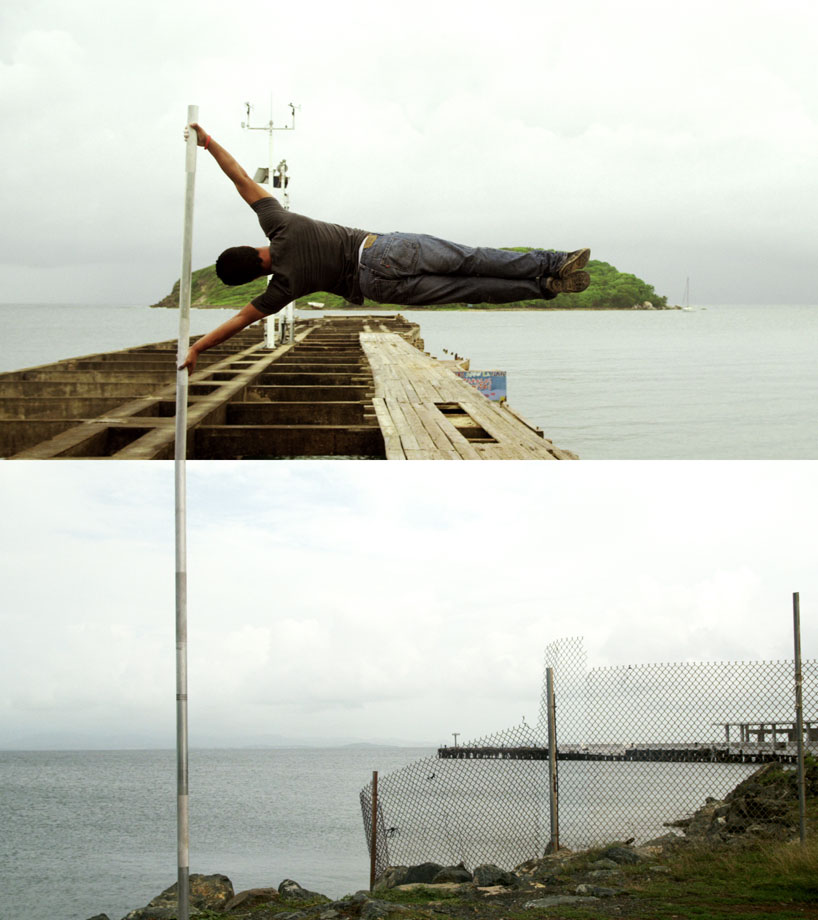
For the Biennale, Allora and Calzadilla present Gloria, a five piece exhibition deeply concerned with what it means to be American today, specifically focusing on competition, condition, and display.  The upturned tank of Track and Field immediately imposes upon the entire Biennale with its size and incessant racket.  A figure poised atop a pedestal, US Olympians alternate running in place.  Indoors, two gymnasts perform choreographed routines upon sculptural reproductions of first-class airline seats.  In this, Body in Flight, the theatrical quality of the gymnastic routine is dislocated to the confines of a small gallery room where dramatic display becomes excessive and uncomfortable, USA emblazoning across uniforms, while still maintaining the allure and beauty of accomplishment and skill.  Algorithm is a custom-fabricated organ fashioned to play in direct response to a built-in ATM machine used by visitors to the pavilion.  It sings and glorifies a unique composition for each individual transaction.  Armed Freedom Lying on a Sunbed is exactly that, and painfully literal. This is when it gets apparent that they were trying to do a lot in a short amount of time. The exhibition wraps up with Half Mast/ Full Mast, a video continuing the collaborators’ series on the Puerto Rican island of Vieques, which the US Navy used as a military base and bombing practice range after relocating citizens.  Through a fractured frame, the video shows a man lifting himself horizontally in place of a national flag over different cites relevant to the island’s historical struggle for freedom and rights.

On the whole, I have mixed feelings about Gloria.  I respect what Allora and Calzadilla are trying to do.  These pieces are loud and aggressive, and some things they do well.  The absurdity is often effective, creating a disturbing middle ground between horror and humor.  Using the belligerent and imposing nature of US policymaking and military strategy as a method for presenting artworks creates a painfully tangible affect, holding a mirror up to the beast, and they function as critique that way.  But is it dangerous for an artist to adopt the methodology of the system they critique as a means to build metaphor?  My concern is that in the overstatement and imposition that mirrors American systems, the work itself, perhaps its poetry, becomes cold, calculated, overly didactic, and hyper-aware of its diplomacy, its many ways of relating to the international viewer.  Surely art-making requires its distinct way of functioning to function well.

I also wonder if there are epic contradictions in the cost required to produce these grand, perfect objects of “American art” that then critique consumerism with an ATM, indulgence and narcissism with a tanning-bed, and capitalist imperialism with a tank.  It’s a tank!  Do you know how much that cost to get to Venice?  Only the USA would do that…right?  So in mimicking, do Allora and Calzadilla’s works come close to committing the crimes they condemn?  Does the work lose power associated with the artists’ individual methodologies by adopting another system’s?  Or is the artistic gesture and the final product worth that sacrifice?
-Katie Smither

Friday, June 3, 2011

Paris is Burning

It is vexxing, grotesque, erotic and sensual, seductive, liberating, alien--all of the hot-button words we have, at present, come to associate with beauty.

You want me to say who I am and all that?! (demure)
Paris is Burning (1990) if you haven't seen it, is a quintessential New York film--a glimpse into what anthropologists will refer to as the metropolitan male sexual paradigm of the post-modern era. The film is charming, humorous, enlightening, gritty--certainly disturbing for the uninitiated. The director in you will love Jennie Livingston's and Paul Gibson's set up. The poet in you regards this as one of the most quotable films of all-time. The cast of characters--and they are characters....

The good Queens of Paris's Ball are the mothers of a generation of self-styled legends. The House of Labeija. The House of Ninja. The House of Xtravaganza. These are the old crews--ala The Warriors but a little less tame than any of the post-punk gangs of that fictional New York City. What is absolutely striking about the film is not the surface idea of a cast of Live Queens--as may be the case perhaps for the uninitiated--it is the way the film and its characters discuss candidly the issues of late 80's New York and America. Press play--the film is immediately sincere, but in no naive sense of the word. Sincere--not quite cynical, certainly hopeful--definitely unshy.

Perhaps my favorite scenes are of the two Latino boys out on the street at 2 am--just after the introduction of Venus Xtravaganza. One is slighter and more fayish (15) with his arm draped arm the more boyish (13--sipping a Sunkist). They are both asked what they're doing out so late and--of course--where's your mother?! The fayish boy responds "I don't have a mother." The director chooses then to have Pepper's voice, over the scene of these two boys, lamenting the sad past that breeds many young legends and Queens.

Yet another question present here is the glorification of whiteness--socio-economic whiteness--let's be clear. We must consider the arguments of Bell Hooks--and rightly so--but again consider this world as a bulwark against the entropy that is: surrendering the ego for the sake of the social structure. The men and women, the Mothers and Legends of the film (particularly Venus who is outwardly expressive of her desire to be a spoiled white woman) are enacting a Bluest Eye mentality. BUT they are also resisting this Bluest Eye mentality in the formation of the House and the Ball. These two acts/traditions gather the community--almost entirely Black and Latino--in a space that may reflect the garb of white america, but does not expressly reach for or attempt to be that world. Pepper, at one point in the film, directly acknowledges his manhood and the satisfaction of knowing that he could never change--that he could never know what or how a woman feels. His only experience, he acknowledges, is as a man or as a man dressed as a woman. So it seems to me they are glorifying the black male figure, despite its vestiture. It is its own sovereign entity with its own legislation--an exclusive zone that is simultaneously the American commodity and the American satire--a reflection of White American narcissism. White America (what we can consider white america) could NOT know itself as an entity without Paris, synecdochically speaking.

It becomes a question of distance and negation.

I cannot entirely agree with Bell. Much of that issue comes from the directorial choices of Jennie Livingston and Paul Gibson who frequently juxtapose the real talk, the dark secrets of these Queens with shots of white America's socially acceptable fashion model. This, in effect, creates/draws an unfathomable distance between the protagonists of the film (blacks and latinos) and the penelope figure (whiteness). In drawing this distance Livingston builds the pseudo-drama and pseudo-peril of entertaining a lifestyle that is "irrational", i.e. How does a black man ever become a white woman? This technique is frequently draped over black narratives to portray an impossible, almost tragic ineffectuality. Seriously? But, returning to my point, I found the characters of this film to be so incredibly beautiful in their experience, in their bravery and singularity--how could this be tragic? How could this simply be an aping of white america? Let's rid ourselves of the stigma and rhetoric of the bluest eye and focus on the dynamic of the spectator. We are aware of this odd fetishization enacted--but perhaps we should be looking outside of ourselves for the cues that provoke early infatuations (obsessions) with whiteness?

Who is watching? Who is telling the story--your story? Who is attempting to co-opt or eat (like Pac Man) the subversive exclusivity and warmth present at the inception of these communal gatherings. Hip Hop holds the same nativity story. White America (What we can consider white america) cannot deal with Black people in love with each other in places where white folk don't fit in. As well consider that the subject of black male sexuality is something that sits on everyone's subconscious. Generally as a thing provoking fear or suspicion. (Most people don't even know that Andy Warhol was a dandy drag--and no one cares, because he was "cool white Andy")

The truth of the matter is that Paris's Ball is a gathering of beautiful, exclusive individuals. Who let Jennie in? Did she even pay admission? (Actually she didn't--the actors saw little of the film's fiscal rewards) Claiming white guilt is no absolution. But here is another fact--each of the characters wanted fame and rockstar status. Essentially, each became rockstars. Like any good rockstar--many met violent/painful or conspicuous ends. It's a question of perspective then. Do you find Jim Morrison tragic? Do you find Jimi Hendrix tragic? Donald Goines? Plath? What about Rimbaud? What about Keats?...

--Andrew E. Colarusso

More on Drag and Paris is Burning:

Friday, May 27, 2011

Stay Cool Friday: Spike Lee as Robin Hood (The Spizikes)


It wasn't Errol Flynn. It was a cold day in '06. October 21, it might have been. Spike Lee in collaboration with the Jordan brand ushered in a limited release, NYC exclusive, collector's edition pair of sneakers. He appeared in three stores (if memory serves) across New York City, all in one day. Short, black Santa Claus. My friend and I camped out in line for two pairs, each $175, outside of Nike NYC. Spike was there to sign each pair, thereby tripling the value of the sneakers. When I finally made it in line to meet Black Brooklyn Santa I gushed about Do The Right Thing and he was modest and grateful. Then he said, you're going to sell these right? He winked. I replied, nah. Then I winked. It was perhaps one of the most benevolent and direct things a person of his stature has ever done to give back to the young and young-at-heart NY fam (at least I think so, us children of the 80's and 90's).
As you can plainly see, the Spiz'ikes were a bit too garish for one's personal stash of exclusive sneakers--designed, as they were, to be an amalgam of different Air Jordans with the cherry-on-top crest of Mars Blackmon. We knew (those in the know) that this was an act of generosity and fun-loving by a great collector and connoisseur. Not to mention a fat check for the involved parties. But for the little person (I stand 5'5 on a good day--Spike probably isn't much taller) this was a great victory. My friend and I made a lot of money in the following week. Really a lot of money for high school juniors in a few days. Over a G.

Thanks Spike. It was a good move. Always at the heart of Brooklyn.


Mister Señor Love Daddy sez:

Today's Forecast: Hot!


--Andrew E. Colarusso

Wednesday, January 19, 2011

Gilda Radner: It's Always Something

There are some poems I hear read that remain in my memory. Certain voices have a particular music. Certain personas leave indelible traces. For example, Ron Mann's film Poetry in Motion is one of my favorite films of contemporary poetry. And every voice in that film/documentary has stayed with me. I even find these voices manifested in subtle ways when I read my own work. Colossal poets. Amiri Baraka, Helen Adams, Jayne Cortez, Ntozake Shange, Robert Creeley, John Giorno, Diane DiPrima, Michael Ondaatje, Jim Carroll, Miguel Algarin--really just to name some of the talent. And an unforgettable smattering of drunken post-modernisms by Charles Bukowski, sitting in front of a goose lamp looking cool as death. So the music of a confident poet's voice stays with you long after they've departed, leaving the trace of their uncanny invention.

This morning I found myself left with the voice of Gilda Radner's late 70's SNL persona, Roseanne Roseannadanna. I felt a need to hear the character's voice. I felt the need to see her strangeness. Her accent is unplaceable. Her hair is invincible. Something about her exuberance is attractive in a way.

I'd heard the name Gilda Radner, but never knew the character of Roseanne Roseannadanna to be her invention. Roseanne is funny and memorable and clever--in dialogue and inception. Roseanne is a character that seems familiar, like a distant relative you know you should call but would rather not speak to on the phone because they have a bad habit of ranting...You know the one. The voice is so subtly inflected (despite its volume) and the repetition of her name is just so satisfying and its arrogance is only saved by her insouciance. Gilda finishes each performance of Roseanne with a corny little ditty based on an old standard (like happy birthday--an easy lyrical piece) and even if it doesn't have the biting sarcasm of modern juvenalia (Family Guy) it will leave you with a smile. It leaves me with a smile. Its a nice reminder that comedy doesn't have to be nasty (although its wonderful when it is). Silliness is a wonderful thing too.

Gilda was married to Gene Wilder in the south of France (according to Wikipedia). Five years later she was gone. Gilda died young. 42. Gene Wilder said this of her in her last moments. After painfully resisting a morphine treatment she feared she would not wake from.


I stayed at her side late into the night, sometimes sleeping over. Finally a doctor told me to go home and get some sleep. At 4 am on Saturday, I heard a pounding on my door. It was an old friend, a surgeon, who told me, "Come on. It’s time to go." When I got there, a night nurse, whom I still want to thank, had washed Gilda and taken out all the tubes. She put a pretty yellow barrette in her hair. She looked like an angel. So peaceful. She was still alive, and as she lay there, I kissed her. But then her breathing became irregular, and there were long gaps and little gasps. Two hours after I arrived, Gilda was gone. While she was conscious, I never said goodbye.

It hurt to read this after having discovered and enjoyed the character of Roseanne. After she passed, of ovarian cancer, Gene established the Gilda Radner Ovarian Detection Center to screen high risk patients. Gilda's cancer psychotherapist, Joanna Bull, with help from Gene, founded Gilda's Club.


"I said to myself, RR, yes you can. I'm ok. You're ok. I'm my own best friend. My mother, myself. I have no fear of flying. I'm woman, hear me roar."

-Gilda Radner as Roseanne Roseannadanna 1979

-Andrew E. Colarusso