Showing posts with label Movies. Show all posts

Friday, September 12, 2014

The Zealot's Guide to Jurassic Park

by Andrew E. Colarusso & Katie Smither


It doesn't take a scholar to deduce that Steven Spielberg was one of the last great movie makers of the 20th century. Ask anybody, especially children raised through the nineties, what their favorite Spielberg film is and you'll likely hear the words "Jurassic Park". In many ways it was the perfect film to inaugurate the election of Bill Clinton, baby boomer extraordinaire. Like the Clinton Administration, Jurassic Park offered excess, escape, dramatic returns, and above all, spectacle. High art may have its devoted audience, but spectacle is universal. Jurassic Park is one of the highest grossing films of all time, and continues to earn income as a successful franchise long after its 1993 debut. In fact, a fourth film in the franchise is due for theatrical debut next year (2015)

Alas, Jurassic Park, the original film, is short on plot continuity. So distracted by the spectacle, and then panic, of dinosaurs set loose in an anthropocenic world, the audience neglects to remember or even notice certain character realities. This is where the film begins to really signify. But how?

Wednesday, May 7, 2014

The Amazing Spider Man 2 Movie Review


You see it all in 3-D
It's your favorite foreign movie
-"Peg" Steely Dan

*****
4/5 Stars

The Amazing Spider-Man 2
Like that partner you, by some miracle, managed to hold on to for a while--The Amazing Spider-Man 2 came and went in tragic-comically predictable fashion, and made for the two most beautiful and notable hours of your young life. You knew it wouldn't last, but Oh Lord did it make you feel good and leave you wanting more. And even though you experienced its beauty from the back of Brooklyn's dingiest movie theater, it felt like you were sitting in the Taj Mahal (not, in reality, the Kent) wearing Cazal shades instead of cheap 3D lenses. 

The Amazing Spider-Man 2 was a revelation. A marvelous breath of fresh air into a flagging brand, a flagging icon. Andrew Garfield as Peter Parker/Spider-Man is utterly charming in a way that Tobey Maguire could never achieve. And I found myself falling deeply and mysteriously in love with Emma Stone as the tragic Gwen Stacy. Their onscreen chemistry is real and cheesy and everything you secretly want for your friendly neighborhood Spider-Man. Dane DeHaan is a fantastically entertaining Green Goblin/Harry Osborn. He's captured as a simultaneity of doe-eyed young man-child on the cusp of his sinister inheritance. As Stan Lee has suggested, Spider-Man's greatest foe is Doctor Octopus, but Peter Parker's greatest foe is the Green Goblin. The Amazing Spider-Man 2 treats us to a fine portrait of Peter Parker qua Spider-Man and the Green Goblin as his mad nemesis. The best villains of course are those we can empathize with. Which brings me to the unexpected star of the show, Jamie Foxx as Electro.

Saturday, October 6, 2012

Fool's Gold: Abstract Economy in Miyazaki's Spirited Away


Miyazaki's films, particularly those produced by Studio Ghibli, have for a long time been a source of joy and inspiration for me. And I do not use joy lightly. Joy, as a facet of the human experience, is distinct from happiness in that Joy is not circumstantial, per se. Happiness can be chemically replicated. Endorphins, dopamine, tryptophan and oxytocin are just a few of the naturally occurring hormones and neurotransmitters the body produces that elicit feelings of happiness, well-being, comfort and love. In essence, happiness can (and has been) produced for general consumption. Joy, on the other hand, is innate/internal and does not necessarily have a mode of expression or replication. Joy is spiritual. Or, more concretely, Joy is the positive manifestation of a healthy relationship with one's memory. 

It is in this sense that I relate to Miyazaki's films. Of his Studio Ghibli films, I think most often of "Spirited Away". I remember thinking that the music moved so elegantly through and between each scene. It was my first Miyazaki film, and from outset to conclusion I was rapt in the Bizet-esque* (cf. Nietzsche's Der Fall Wagner) presentation of the real beside the spiritual. The color palette was so stimulating and vibrant, without being garish (cf. Spongebob) and the various depictions of light, natural and otherwise, were hauntingly beautiful (cf. Picasso's Le Moulin de la Galette). But what has truly captured my imagination, since I first saw the film several years ago, is the uniquely accessible semiotic woven through the fibers of the film's narrative.

"Spirited Away" is a Derridean archive--a discursive matrix of representations. As night begins to fall on the mysterious netherworld and the spirits begin to articulate their forms, Miyazaki calls for the viewer's embarkation.


At this point, always, I begin to feel as though I'm tangibly reacquainted with the curious mystery of youth, my youth, and its tender evaporation. It's not necessarily a negotiation/hermeneutic of life and death. It's not nostalgia per se. I think it's a joyful embarkation on the ferry of a master storyteller--the excitation of suspending reality in favor of the imaginary that I equate with my young mind (or the young part of my mind) It is a new world, not of my own imagination, but like the experience of deja vu, Miyazaki's imagined world bears a strange resemblance to my own. This elicits desire--a desire to explore and discover his world and its spirits. Returning to this notion of the film as archive, my recent preoccupation has been with the quiet, creeping wraith called No-Face.


No-Face is a sort of ethereal creature, more so than the other spirits in that he has no full form, wears no expression, and serves no knowable purpose--hence No-Face. He is masked at all times and from the start of our protagonist's (Chihiro/Sen) journey across the bridge into the spirit world, No-Face, who seems to see through her temporary invisibility, is aware of her presence. Shortly after settling into her new world, Chihiro (who is now called Sen) encounters for the first time the foreboding presence of No-Face on the bridge. It isn't until later that evening, when Sen allows No-Face to enter the bathhouse, that No-Face presents his unique ability. He can materialize gold in the palm of his ghostly hands. He also intervenes on her behalf during her first bath task, bringing her an excess of bath tokens (which are required to initiate specific bath water combinations for soiled spirits). No-Face's character, for the majority of the film, operates within this unusual economy. His multifarious lack--lack of identity, lack of purpose, lack of voice--is channeled into his excessive desire to create and then give, a sort of philanthropic impulse with questionable intention. His silence, for much of the film (until he begins eating other characters), further underscores No-Face's questionable character.


Sen, who he's taken a liking too, often refuses his excessive gifts, finding that they serve her no purpose. Feeling rebuffed by her, No-Face begins to produce tremendous quantities of gold, drawing the greedy attentions of the bath house workers who try to appease his unseemly appetite. He begins to consume ravenously and with no regard for the lives of the bathhouse inhabitants. He is transformed from a quiet figure of longing, into a monster of consumption. This is a major thematic thread in the film. Each of the characters in the film, with the exception of our protagonist, is at some point tempted and transformed (or nearly transformed) by the anti-promise of material wealth and sensual satisfaction. In this sense, No-Face is the embodiment of the film's central preoccupation. 

How then do we, can we read No-Face? The deceptively generous wraith is, in many ways, a Jungian dream archetype that we've all encountered--the joyless manifestation of an unrequited desire. No-Face is a sort of haunting or hauntedness. Have you ever been courted by someone whose desire, you both knew, was not in the right place? Rational communication breaks down (between self and self [denial], between self and other) and the gesture of generosity, with the intention of possessing the object of desire, becomes a vacuum of consumption where notions of wholeness are lost, collapsed. No-Face, we begin to realize, is sick. Of course, Sen's solution to his illness in the film works through a great deal of magic. Perhaps it takes a little magic to fill the no-face void in each of us--the void that haunts us in the middle of the night and motivates us to move, to create, to consume or be consumed. And perhaps it takes some faith to know that this void is not necessarily a malign force operating within the self. 

...

from The Perforator God
by Ariana Reines
(Mercury, Fence Books, 2011)

...

A silver corsair

In a violet distance

That I am capable of imagining

Inside a world

In which the cashew-colored sky

Emits a musk

Of snow

Is the zone in which

I will lay down what's most harassed in me

And make it die.

...

Thursday, April 12, 2012

Short Films Round Up: "New Boy" and "8 Bits"

b y   A N D R E W   E.   C O L A R U S S O

New Boy (2007), directed by Steph Green and based on a short story of the same name by Roddy Doyle (a Booker award winning Irish novelist) portrays a brief episode in the life of a young Rwandan transplant during his first day at his new school. With close up shots and touching flashbacks the "new boy", named Joseph (Olutunji Ebun-Cole), is gradually fleshed out into a full character. Because it's a short film, many of the other characters do not have space enough within the narrative to become anything more than catalysts for the development of the protagonist's character/self-hood. Even still, each of the players in this 11 minute film have distinct personalities--the cinematography (P.J. Dillon) and the gripping humanity of Doyle's narrative gives everyone in the movie a sufficient amount of mystery and gray space. 

It's almost as though the viewer is experiencing the first day of school, with Joseph, all over again. The close shots and tight angles, frequently over the shoulder, heighten anxiety, first-day jitters and the feeling that at any moment something could pop-off. I found myself considering the group dynamic immediately--and it became clear to me, again, why school was such a pain in the ass. It's hard enough to learn the "times-table" without having to worry about attaining some status within a new group. 


Another incredibly fascinating aspect of the film is the way race is portrayed. Because they're students in grade school we're given a sort of naive, though budding, sense of race and racial difference. Not since "In America" (Jim Sheridan) and "The Crying Game" (Neil Jordan) have I seen a film from the Eire with such heart and sensitivity to matters of race. Also worth noting, the film was nominated for an Academy Award in 2009. 

In short, New Boy is a film worth watching. It's warm and charming, without being obnoxious and the acting, primarily captured in these close, intimate shots, was enough to make me tear up. 7/10

***

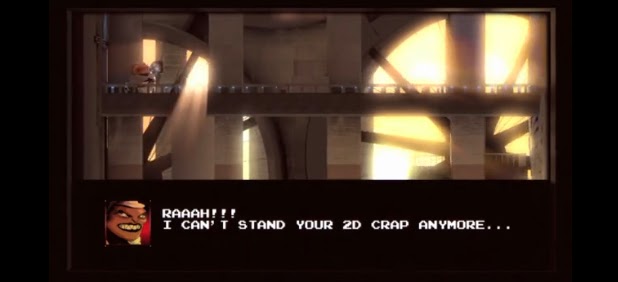
8 Bits (2010), from what I've gathered, is a French production voiced in English and set in a mysterious digital realm. This is a movie for video game lovers. In fact, it's a 7 minute paean to the history of gaming. There is hardly any dialogue (only one actor is credited)--what really stands out here is the digital mis-en-scene evoking nearly every classic video game you've ever (or never) played. This film has more in common with a video game than it does with the traditional elements of a short film. Essentially, it's a fun little ride that could have been a graduate thesis. It definitely banks on the viewer's nostalgia for an 8 bit, 2D platformer world of video games. I'd guess the prime viewing demographic to be somewhere between the ages of 22 and 39, + or - 3. 


The protagonist is clearly the protagonist (a 30-something couch potato with a walk man and a five o'clock shadow) questing to rescue his mute and captured demoiselle from a tyrannical villain with filed teeth, a bad ass (if at times unintelligible) voice and an ill-fitted suit. Perspective shifts between 3D and 2D making for interesting little cutscenes. Credit must be given to the design team--8 Bits is a visual feast. But the real bread and butter of this movie, what makes it really go, is the soundtrack. We're given an auditory feast of midi beats and sound effects that really bring to mind a sort of "golden age" of gaming--if ever there was one. 

8 Bits is worth a watch. It's like a swag bag of sights and sounds. 6/10