Showing posts with label Miscellany and Fun-Loving. Show all posts

Wednesday, April 12, 2017

Review of "Breakfast"

April 12, 2017

Though this humble reviewer woke on the wrong side of the bed (lingering headache / overwarm / dry scalp) we also woke with a healthy dose of quiet reverence for the absolute transit of things. In yesterday’s lecture on Claudia Rankine’s “Don’t Let Me Be Lonely,” we finally lighted on the potent truth that Rankine’s relationship with and nearness to death keeps her from the illusion of life as it’s been sold to us through market capitalism. That nearness to death, nonetheless, does not prevent us from being excited for this morning’s much anticipated, much talked about “Breakfast”. 

Inspired by yesterday’s “Dinner,” this morning’s “Breakfast” featured mid-career performances from the Blackberries (6 oz.),  Greek Yogurt (Greek God / four scoops / non-fat / plain), apple-cinnamon-raisin Granola (Creative Snacks Co.), and the never-on-schedule (but always on time) Cinnamon, performing live. 

Unfortunately we must confess this morning’s “Breakfast,” while featuring an all star cast and stellar production value, failed to live up to this humble reviewer’s humble expectations. 

The Blackberries looked to be in good shape. The Greek yogurt, brand new. Interesting to note: what distinguishes Greek yogurt from plain yogurt is process. The whey is strained, leaving us with less liquid and more protein. A denser/richer product than its more common counterpart. The Granola (prepackaged) tumbled out of its matte-finish, plastic confines eagerly. The Granola’s publicist held a brief press conference after taping had commenced to address questions of wholesomeness. She assured the anxious public that the Granola was in fact, “...artificial flavor, color, and preservative free!" NO HIGH FRUCTOSE CORN SYRUP HERE! Announced the publicist before leaving abruptly. Together the trio was mixed and mastered in a remote, New England studio. 

After our first bite, satisfied to see this project actualized, we breathed a sigh of relief. After all the press chatter, blog buzz, and delays, “Breakfast” was complete. And we could now enjoy it while watching reviews of other things on youtube. But after our third bite (we must be honest with you reader) the bowl fell flat. What really had us frowning was the hardness of the raisins which stuck to our teeth and gums like a very very hard and sticky thing.  Eyebrows were raised. Fortunately, after spoon three, it dawned on us that Cinnamon was meant to be present. And so, Cinnamon arrived later than expected for a live performance, reminding us of the health benefits of this wildly touted “Breakfast”. Cinnamon reassured us, all proceeds go to charity

Alas. It wasn’t until the penultimate spoonful that it happened. The explosion of bright berry flavor we so desperately wanted had finally come through. Perhaps too late. This is what we were missing. This is what we wanted more of. 

Our final verdict:
6.7 / 10

Friday, October 28, 2016

Kissing the Frog(s)

Kissing the Frog(s)
On Love and Pokémon, 
Schopenhauer and the Masuda Method

Luckily we were met by ordinary devotion. 
—D. W. Winnicott
Did you teach him how to surf, is perhaps where it started. It’s 1998. Sheldon A. Brookner. P.S. 135 on Linden Blvd. Brooklyn, New York City where they paint murals of Biggie…You’re sitting at a collapsible cafeteria table, rapt in classmate conversation, each of them bubbling with excitement over something. Some new thing. You’re not sure what. Curious, you ask: what’re y’all talking about? 

You dunno Pokémon?

Shortly thereafter you acquire as a gift from your father Pokémon Blue, the one featuring on its cover the giant blue turtle with the cannons on its back. As it happens, your parents only learn about the games overtly Bio-Darwinian themes (evolution, genetic signatures, and later, breeding) after you’re knee deep in the game’s consuming (consumerist) time-suck. In fact, the game becomes controversial (just as Harry Potter would) with Christian conservatives and you begin to feel compromised. This will happen later with Grand Theft Auto: San Andreas. Remember Hot Coffee? No,  of course you don’t. 

But back to Pokémon— On that day, you crack the box open reverently and slide the blue cartridge into your beloved Game Boy. The same day your father, ever the big man, gets into an amusing confrontation with one of the local bloods. You don’t find it funny, but later see the irony in your choice of Blue version over the more popular Red. Little Orphan Annie is blaring from trunk subs as Jay’s Ghetto Anthem climbs the charts. You notice more and more unmarked white vans making their neighborhood rounds. 

And while all of this is happening, Professor Oak (the game’s Dantean/Virgilian psychopomp) cordially greets you, welcomes you to the world of Pokémon, asks your name…

Tuesday, July 21, 2015

The Long Halloween

from Batman: The Long Halloween
Written by Jeph Loeb
Art by Tim Sale

Friday, September 12, 2014

The Zealot's Guide to Jurassic Park

by Andrew E. Colarusso & Katie Smither


It doesn't take a scholar to deduce that Steven Spielberg was one of the last great movie makers of the 20th century. Ask anybody, especially children raised through the nineties, what their favorite Spielberg film is and you'll likely hear the words "Jurassic Park". In many ways it was the perfect film to inaugurate the election of Bill Clinton, baby boomer extraordinaire. Like the Clinton Administration, Jurassic Park offered excess, escape, dramatic returns, and above all, spectacle. High art may have its devoted audience, but spectacle is universal. Jurassic Park is one of the highest grossing films of all time, and continues to earn income as a successful franchise long after its 1993 debut. In fact, a fourth film in the franchise is due for theatrical debut next year (2015)

Alas, Jurassic Park, the original film, is short on plot continuity. So distracted by the spectacle, and then panic, of dinosaurs set loose in an anthropocenic world, the audience neglects to remember or even notice certain character realities. This is where the film begins to really signify. But how?

Thursday, July 10, 2014

Waste Land: A New Literary Experience


Waste Land

Waste Land is an immersive world, a mystery waiting to be unraveled. Designed by Remo Arpagaus, principle designer at White-Ibex Games, and curated by Andrew E. Colarusso, editor-in-chief of the Broome Street Review—Waste Land bridges poetry and game design to create an all new interactive literary experience. The first of its kind!

Wednesday, May 7, 2014

The Amazing Spider Man 2 Movie Review


You see it all in 3-D
It's your favorite foreign movie
-"Peg" Steely Dan

*****
4/5 Stars

The Amazing Spider-Man 2
Like that partner you, by some miracle, managed to hold on to for a while--The Amazing Spider-Man 2 came and went in tragic-comically predictable fashion, and made for the two most beautiful and notable hours of your young life. You knew it wouldn't last, but Oh Lord did it make you feel good and leave you wanting more. And even though you experienced its beauty from the back of Brooklyn's dingiest movie theater, it felt like you were sitting in the Taj Mahal (not, in reality, the Kent) wearing Cazal shades instead of cheap 3D lenses. 

The Amazing Spider-Man 2 was a revelation. A marvelous breath of fresh air into a flagging brand, a flagging icon. Andrew Garfield as Peter Parker/Spider-Man is utterly charming in a way that Tobey Maguire could never achieve. And I found myself falling deeply and mysteriously in love with Emma Stone as the tragic Gwen Stacy. Their onscreen chemistry is real and cheesy and everything you secretly want for your friendly neighborhood Spider-Man. Dane DeHaan is a fantastically entertaining Green Goblin/Harry Osborn. He's captured as a simultaneity of doe-eyed young man-child on the cusp of his sinister inheritance. As Stan Lee has suggested, Spider-Man's greatest foe is Doctor Octopus, but Peter Parker's greatest foe is the Green Goblin. The Amazing Spider-Man 2 treats us to a fine portrait of Peter Parker qua Spider-Man and the Green Goblin as his mad nemesis. The best villains of course are those we can empathize with. Which brings me to the unexpected star of the show, Jamie Foxx as Electro.

Saturday, October 6, 2012

Fool's Gold: Abstract Economy in Miyazaki's Spirited Away


Miyazaki's films, particularly those produced by Studio Ghibli, have for a long time been a source of joy and inspiration for me. And I do not use joy lightly. Joy, as a facet of the human experience, is distinct from happiness in that Joy is not circumstantial, per se. Happiness can be chemically replicated. Endorphins, dopamine, tryptophan and oxytocin are just a few of the naturally occurring hormones and neurotransmitters the body produces that elicit feelings of happiness, well-being, comfort and love. In essence, happiness can (and has been) produced for general consumption. Joy, on the other hand, is innate/internal and does not necessarily have a mode of expression or replication. Joy is spiritual. Or, more concretely, Joy is the positive manifestation of a healthy relationship with one's memory. 

It is in this sense that I relate to Miyazaki's films. Of his Studio Ghibli films, I think most often of "Spirited Away". I remember thinking that the music moved so elegantly through and between each scene. It was my first Miyazaki film, and from outset to conclusion I was rapt in the Bizet-esque* (cf. Nietzsche's Der Fall Wagner) presentation of the real beside the spiritual. The color palette was so stimulating and vibrant, without being garish (cf. Spongebob) and the various depictions of light, natural and otherwise, were hauntingly beautiful (cf. Picasso's Le Moulin de la Galette). But what has truly captured my imagination, since I first saw the film several years ago, is the uniquely accessible semiotic woven through the fibers of the film's narrative.

"Spirited Away" is a Derridean archive--a discursive matrix of representations. As night begins to fall on the mysterious netherworld and the spirits begin to articulate their forms, Miyazaki calls for the viewer's embarkation.


At this point, always, I begin to feel as though I'm tangibly reacquainted with the curious mystery of youth, my youth, and its tender evaporation. It's not necessarily a negotiation/hermeneutic of life and death. It's not nostalgia per se. I think it's a joyful embarkation on the ferry of a master storyteller--the excitation of suspending reality in favor of the imaginary that I equate with my young mind (or the young part of my mind) It is a new world, not of my own imagination, but like the experience of deja vu, Miyazaki's imagined world bears a strange resemblance to my own. This elicits desire--a desire to explore and discover his world and its spirits. Returning to this notion of the film as archive, my recent preoccupation has been with the quiet, creeping wraith called No-Face.


No-Face is a sort of ethereal creature, more so than the other spirits in that he has no full form, wears no expression, and serves no knowable purpose--hence No-Face. He is masked at all times and from the start of our protagonist's (Chihiro/Sen) journey across the bridge into the spirit world, No-Face, who seems to see through her temporary invisibility, is aware of her presence. Shortly after settling into her new world, Chihiro (who is now called Sen) encounters for the first time the foreboding presence of No-Face on the bridge. It isn't until later that evening, when Sen allows No-Face to enter the bathhouse, that No-Face presents his unique ability. He can materialize gold in the palm of his ghostly hands. He also intervenes on her behalf during her first bath task, bringing her an excess of bath tokens (which are required to initiate specific bath water combinations for soiled spirits). No-Face's character, for the majority of the film, operates within this unusual economy. His multifarious lack--lack of identity, lack of purpose, lack of voice--is channeled into his excessive desire to create and then give, a sort of philanthropic impulse with questionable intention. His silence, for much of the film (until he begins eating other characters), further underscores No-Face's questionable character.


Sen, who he's taken a liking too, often refuses his excessive gifts, finding that they serve her no purpose. Feeling rebuffed by her, No-Face begins to produce tremendous quantities of gold, drawing the greedy attentions of the bath house workers who try to appease his unseemly appetite. He begins to consume ravenously and with no regard for the lives of the bathhouse inhabitants. He is transformed from a quiet figure of longing, into a monster of consumption. This is a major thematic thread in the film. Each of the characters in the film, with the exception of our protagonist, is at some point tempted and transformed (or nearly transformed) by the anti-promise of material wealth and sensual satisfaction. In this sense, No-Face is the embodiment of the film's central preoccupation. 

How then do we, can we read No-Face? The deceptively generous wraith is, in many ways, a Jungian dream archetype that we've all encountered--the joyless manifestation of an unrequited desire. No-Face is a sort of haunting or hauntedness. Have you ever been courted by someone whose desire, you both knew, was not in the right place? Rational communication breaks down (between self and self [denial], between self and other) and the gesture of generosity, with the intention of possessing the object of desire, becomes a vacuum of consumption where notions of wholeness are lost, collapsed. No-Face, we begin to realize, is sick. Of course, Sen's solution to his illness in the film works through a great deal of magic. Perhaps it takes a little magic to fill the no-face void in each of us--the void that haunts us in the middle of the night and motivates us to move, to create, to consume or be consumed. And perhaps it takes some faith to know that this void is not necessarily a malign force operating within the self. 

...

from The Perforator God
by Ariana Reines
(Mercury, Fence Books, 2011)

...

A silver corsair

In a violet distance

That I am capable of imagining

Inside a world

In which the cashew-colored sky

Emits a musk

Of snow

Is the zone in which

I will lay down what's most harassed in me

And make it die.

...

Thursday, April 12, 2012

Short Films Round Up: "New Boy" and "8 Bits"

b y   A N D R E W   E.   C O L A R U S S O

New Boy (2007), directed by Steph Green and based on a short story of the same name by Roddy Doyle (a Booker award winning Irish novelist) portrays a brief episode in the life of a young Rwandan transplant during his first day at his new school. With close up shots and touching flashbacks the "new boy", named Joseph (Olutunji Ebun-Cole), is gradually fleshed out into a full character. Because it's a short film, many of the other characters do not have space enough within the narrative to become anything more than catalysts for the development of the protagonist's character/self-hood. Even still, each of the players in this 11 minute film have distinct personalities--the cinematography (P.J. Dillon) and the gripping humanity of Doyle's narrative gives everyone in the movie a sufficient amount of mystery and gray space. 

It's almost as though the viewer is experiencing the first day of school, with Joseph, all over again. The close shots and tight angles, frequently over the shoulder, heighten anxiety, first-day jitters and the feeling that at any moment something could pop-off. I found myself considering the group dynamic immediately--and it became clear to me, again, why school was such a pain in the ass. It's hard enough to learn the "times-table" without having to worry about attaining some status within a new group. 


Another incredibly fascinating aspect of the film is the way race is portrayed. Because they're students in grade school we're given a sort of naive, though budding, sense of race and racial difference. Not since "In America" (Jim Sheridan) and "The Crying Game" (Neil Jordan) have I seen a film from the Eire with such heart and sensitivity to matters of race. Also worth noting, the film was nominated for an Academy Award in 2009. 

In short, New Boy is a film worth watching. It's warm and charming, without being obnoxious and the acting, primarily captured in these close, intimate shots, was enough to make me tear up. 7/10

***

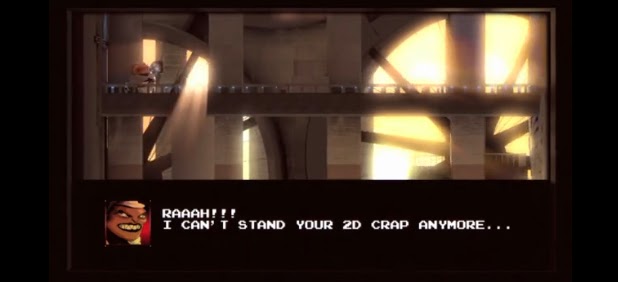
8 Bits (2010), from what I've gathered, is a French production voiced in English and set in a mysterious digital realm. This is a movie for video game lovers. In fact, it's a 7 minute paean to the history of gaming. There is hardly any dialogue (only one actor is credited)--what really stands out here is the digital mis-en-scene evoking nearly every classic video game you've ever (or never) played. This film has more in common with a video game than it does with the traditional elements of a short film. Essentially, it's a fun little ride that could have been a graduate thesis. It definitely banks on the viewer's nostalgia for an 8 bit, 2D platformer world of video games. I'd guess the prime viewing demographic to be somewhere between the ages of 22 and 39, + or - 3. 


The protagonist is clearly the protagonist (a 30-something couch potato with a walk man and a five o'clock shadow) questing to rescue his mute and captured demoiselle from a tyrannical villain with filed teeth, a bad ass (if at times unintelligible) voice and an ill-fitted suit. Perspective shifts between 3D and 2D making for interesting little cutscenes. Credit must be given to the design team--8 Bits is a visual feast. But the real bread and butter of this movie, what makes it really go, is the soundtrack. We're given an auditory feast of midi beats and sound effects that really bring to mind a sort of "golden age" of gaming--if ever there was one. 

8 Bits is worth a watch. It's like a swag bag of sights and sounds. 6/10


Wednesday, April 4, 2012

Our exclusive preview of Art:21, season 6


a r t : 2 1 : 6

The good folks representing PBS's incredible series on art in the 21st century (DKC) were kind enough to forward us a preview copy of season 6! I have to say, this is my favorite season by far. It premieres friday, April 13th at 9pm (est)

This season's four episodes:

CHANGE

BOUNDARIES

HISTORY

BALANCE

Glenn Ligon: from the Runaways series

Tuesday, January 24, 2012

Thursday, January 5, 2012

Ode to Bolo Yeung

If you haven't seen Bloodsport, perhaps you should. It's a Jean-Claude Van Damme* film, essentially--debuted 1988. No, it's not particularly good, but maintains a respectable cult following. I suppose I can include myself, casually, within this cult. It is perhaps Bolo Yeung's second major American showing and the first time I would recognize him, by face, as the quintessential martial arts villain. His first major American appearance, arguably, was "Enter the Dragon"--Bruce Lee's magnum opus. 


Not much has been said of Bolo in public forums. He is content to play the villain and appears to be a man of few words. The details of his life seem to be shrouded in mystery and myth. But behind the hardened villain is a long devoted tai-chi practitioner and a deeply philosophical man. 

Here's a mini-biography from IMDB:

Bolo Yeung was born in China. He began his martial arts training at the age of 10. Growing up he took an interest in bodybuilding. Later he became know as Chinese Hercules after becoming Mr. Hong Kong bodybuilding champion. He held the title for ten years. Because of his impressively muscular physique he was chosen for several bad guy movie roles, with which his first big break came alongside the legendary Bruce Lee in the 1973 movie Enter the Dragon, where he played the role of 'Bolo'. They were really close friends.

Since then Bolo Yeung has appeared in countless martial arts movies, to date, also working on two movies with "The Muscles from Brussels"-Jean-Claude Van Damme in Bloodsport and Double Impact.

Now Bolo still looks great and still regularly trains at his local gym. Martial Arts and Bodybuilding is an integral part of his life and career.

from Double Impact

Quote:

Among those people who have religion, there are small proportions of people who do good things but conditionally. They are opportunists. The reason why they do good things is the fear of the hell and the desire for the heaven. This kind of person may not necessarily still do good things if there is no heaven or hell. This kind of person made the meaning of people into data. A lot of things are screwy now. Confucianism nearly disappeared. Taoism became the tool to tell geomantic omen. Even the Buddhism temple [has become] a profiting organization. There are even more. But I don't think I would like to talk about it anymore.


A tad sensational, but here Bolo is headlined by his Chinese name: Yeung Si


The very odd thing about this video is how real it is. How JCVD (51) and Bolo Yeung (65) have come so far, have made careers for themselves and still--their silences in this brief clip are remarkable. Mastery is an evasive distinction. These men are masters because after their limelight moments have passed, they continue to find meaning and reason in daily life, in the joy of family and friends, in the prospect of good things to come. 

Not to mention, the question: Why has there been no martial arts movie star to replace Jean Claude Van Damme? Maybe Bolo was just being nice...

*Van Damme's latest film "JCVD" (recognize the initials on his hat in the above clip) is a bit odd, but a worthwhile film. 

Sunday, August 14, 2011

Pause

Jon Witherspoon has been found guilty of harassment charges. "Bang. Bang. Bang. Bang." He said in his defense. 

Sunday, July 24, 2011

Wednesday, June 15, 2011

Mortal Kombat 2011

By Eric Adamson

Mortal Kombat, originally released in the arcade in 1992, is one of the fighting games responsible for defining the 2-D fighting game genre.  The game, of course, probably most known for its fatalities (which I spent hours trying to perform and failed Kontinuously) is deliciously gory and perfectly difficult.  The first game began with the simple selection of seven characters (or Kombatants) and each character had the same basic move set, with a few special moves each – including a unique fatality for each character.  Maybe two but I can’t quite remember.  For us children of the 90s, the game remains an iconic symbol.

The game evolved through many reincarnations and modules, including many game versions, a comic book series, television shows, actions figures, adventure RPG games, and, maybe best of all, several live action movies.  The movies were just as terrible as anyone who hasn’t seen them imagines they would be, but were enjoyable nevertheless.  Perhaps I enjoyed them for the same reason that I enjoyed the X-Men movies, not because the movies were great but because I liked the characters and I liked seeing each character in live action and feeling as though I knew more about them than the movie gave me.  The viewers stick around just to hear Scorpion scream, “Get over here!” when he throws his spears from his hands.  Besides, to an amateur martial arts moviegoer, the fighting looks pretty good.

As the game went through these evolutions, the characters and the world and the storyline became increasingly more Komplicated.  For the standard fan of the game, there is by now, I’m sure, far too much to keep up with, although some of them introduced things that would become iconic for fighting games (remember the guy who pops up in the bottom of the screen sometimes, saying something like, “Woop-Ding!”)  Perhaps this over Komplication was what caused several of the latest Mortal Kombat games that have been released to be flops.  But the most recently released, simply titled Mortal Kombat, takes the game back to its roots.  The fighting platform is back to a 2-D fighting setting, there are far fewer characters, and the story is cut loose from all of the Komplicated and often poorly thought out plot lines of most of the series.  The Mortal Kombat franchise has begun to retell its own story.  Back to the basics, I guess.  Except this return to basics comes with incredible graphics and a host of new moves and combos that you haven’t seen before, as well as many of the old ones.
When does a franchise like this reach the point where things need to be reset?  During its nearly fifty year run, X-Men has done it twice, once unofficially, and once officially (not to mention that about every ten years a set of new characters are introduced in order to allow for a new focus.)  But for a video game franchise with a simple story (the seven greatest warriors of Earth must battle for Earth’s survival!) that grew to be incredibly Komplicated (and not very interesting at that) why restart now?  I suppose much of it is a marketing scheme – X-Men writers say they restarted the storyline because it had grown so Komplicated that a new reader would likely be easily overwhelmed.  For Mortal Kombat, it happens because the developers probably realized that their game’s mechanics were lackluster to other games being released, there isn’t anything interesting in the game play anymore.  Therefore, they must appeal to their original fan base, when newer and younger gamers might as well choose a better game since they have no interest or nostalgic tie to the franchise’s title.  It seems to be working, as this new Mortal Kombat is selling tons of copies and receiving great reviews.  (The best reviews since Mortal Kombat III.)


But I ask the question again from an artistic perspective – why restart?  Are large franchises like this with tons and tons of Kollaborators showing that there can be too many minds at work on one idea?  With the creation of these universes, many artists and writers and programmers come together to put in their own ideas, and once an idea is in, everyone else has to deal with it because it is there.  This insertion now exists in the universe that artist is working in.  And even less so than in the real world, you cannot ignore it, because the very medium being worked with has been shifted by someone else.  Of course, the art direction and story writing for Mortal Kombat has been pretty awful during the entire run, leaving its rise to popularity to be based heavily on the gore which wasn’t present in many games in 1992 – especially with games like Street Fighter providing a much more solid story with interesting art direction and hand drawn characters.


I know that it is a little bit of a stretch to consider Mortal Kombat an artistic endeavor for many reasons – the most obvious being that it really is just a Kash Kow for the developing Kompanies.  What makes it fascinating is that despite all of the flaws in story and art direction, despite the terrible flops of the previous games, this new Mortal Kombat is exceptionally fun and the enjoyment of playing certainly redeems the game of its lack of lore.  Did anyone else just overly enjoy the first time you got to watch you opponents bones being Krushed by your kick to the neck?  Or just me?  Also, I don’t know if I will ever get tired of watching various characters mutilate Johnny Cage with their fatalities. And the best part is yet to come:  Supposedly there is a new Mortal Kombat movie being made (it is unclear from my research whether it is a real movie, a web series, or a web series being turned into a movie) but it looks like something I will be going to see.  Check out this trailer:


It looks like someone with a very nice camera has decided to take an interest in Mortal Kombat.  Hopefully it will not disappoint.
-Eric Adamson

Friday, May 27, 2011

Stay Cool Friday: Spike Lee as Robin Hood (The Spizikes)


It wasn't Errol Flynn. It was a cold day in '06. October 21, it might have been. Spike Lee in collaboration with the Jordan brand ushered in a limited release, NYC exclusive, collector's edition pair of sneakers. He appeared in three stores (if memory serves) across New York City, all in one day. Short, black Santa Claus. My friend and I camped out in line for two pairs, each $175, outside of Nike NYC. Spike was there to sign each pair, thereby tripling the value of the sneakers. When I finally made it in line to meet Black Brooklyn Santa I gushed about Do The Right Thing and he was modest and grateful. Then he said, you're going to sell these right? He winked. I replied, nah. Then I winked. It was perhaps one of the most benevolent and direct things a person of his stature has ever done to give back to the young and young-at-heart NY fam (at least I think so, us children of the 80's and 90's).
As you can plainly see, the Spiz'ikes were a bit too garish for one's personal stash of exclusive sneakers--designed, as they were, to be an amalgam of different Air Jordans with the cherry-on-top crest of Mars Blackmon. We knew (those in the know) that this was an act of generosity and fun-loving by a great collector and connoisseur. Not to mention a fat check for the involved parties. But for the little person (I stand 5'5 on a good day--Spike probably isn't much taller) this was a great victory. My friend and I made a lot of money in the following week. Really a lot of money for high school juniors in a few days. Over a G.

Thanks Spike. It was a good move. Always at the heart of Brooklyn.


Mister Señor Love Daddy sez:

Today's Forecast: Hot!


--Andrew E. Colarusso

Friday, April 22, 2011

Friday, April 8, 2011

Suite for Ma Dukes


Miguel Atwood-Ferguson
J Dilla in memoriam

This gives me all kind of chills

Monday, January 24, 2011

Transmission

John Tenniel

Who are you?
Timeless illustrations from Alice's Adventures in Wonderland by John Tenniel

Saturday, January 22, 2011

A History of Western Philosophy

It is strange that the last men of intellectual eminence before the dark ages were concerned, not with saving civilization or expelling the barbarians or reforming the abuses of the administration, but with preaching the merit of virginity and the damnation of unbaptized infants. Seeing that these were the preoccupations that the Church handed on to the converted barbarians, it is no wonder that the succeeding age surpassed almost all other fully historical periods in cruelty and superstition.

Bertrand Russell, A History of Western Philosophy (New York: Simon and Schuster, 1945), p. 366; see also bk. 2, pt 1, chaps. 3, 4.