Showing posts with label Reviews. Show all posts

Tuesday, December 23, 2014

Ruin: Essays in Exilic Living

by Adrianne Kalfopoulou
Red Hen Press, 2014
pp 179, $15.95
A review by Andrew E. Colarusso

What does it mean to live in ruin(s)? A better question still, how is life humanely experienced in and after loss?

Poet, professor, and essayist Kalfopoulou (Language & Literature/Hellenic American University) explores in her collection of essays the various ways we inhabit liminal space—that is, how each of us might slip into the unforeseen cracks on the sidewalk of life and still manage to live our lives. These essays verge on memoir, revealing vignettes of Kalfopoulou’s life as a nomad (of sorts) in search of personal rootedness, frequently touching on Orphic loss, on what it means to lose something (or someone) invaluable. Born in Vietnam to Greek expatriate parents, mother to a bright and idealistic daughter studying in New York City, professor of language and literature teaching in the middle of a tumultuous Athens, Kalfopoulou’s life is a whirlwind of places, people, and events. From the impersonal interpersonal exchanges of post 9/11 America to the limits of suicide as a means of reclaiming one’s body, Kalfopoulou enacts a free discourse with cosmopolitan candor and maternal tenderness. Each of her essays structurally simulate a relationship between tempo and mood. This can be somewhat overwhelming, given the often episodic nature of her subject matter, but her prose functions as mimetic representation for the experience she conveys. Fragments of significant thought (vignettes/episodes) are expertly braided to poignant and haunting affect. Take for example Ruin’s opening essay “Gift-Giving as Exilic Baggage”, a tragicomic account of her experience checking-in luggage at the airport, literally burdened by excessive souvenirs. Elongated/truncated syntax simulates the breathless pace at which Kalfopoulou moves through restricted space. The rushed, stop-n-go cadences of the essay shoulder a clever metaphor for the exile’s tendency to think of others before self and suffer (pay) for it. Ruin shines in its treatment and knowledge of the divisiveness of power and privilege in the everyday lives of everyday people.

"The language of truth is the language of experience, and when it does not recognize or reflect the language of power, it becomes the language of the refugee, the immigrant..." (26, Dislocated States)

She plumbs the depths of languages (and para-languages) displaced, opening them to the imaginative possibilities of their power and beauty. Like any true astrological Leo (I say this as a proud Leo), Kalfopoulou places herself at center, taking full responsibility for the world around her, sharing all of the pieces of her own "'...individual detail that tend to stray from the schema,'" (54, Miosz) 

Ruin was written to remind us: from a fragmented sense of self, from the memories we carry and the experiences we live, it is possible to cull meaningful wholeness. This is a sui generis collection of sage and relevant essays for a world that seems more confusing daily.

Monday, May 12, 2014

[Early] Impressions of Kara Walker's Sphinx: A Subtlety

By Andrew E. Colarusso

This weekend I had the good fortune and free pleasure of working with Creative Time NYC at Kara Walker's installation in the now defunct Williamsburg Domino Sugar Factory. Yes I understand that the previous sentence was a lot of name dropping, but nothing as it related to this exhibit went unnoticed by the artist. 


This Subtlety (so named for a European tradition of refined and sculpted marzipan treats) is an intellectual marvel of an installation. While Kara's work has always dealt with site and scale remarkably well, this piece calls her into being just as Guernica, its nigh unavoidable tableau of degeneration, called Picasso into being. 
Enigma of the tucked thumb

The Great Sphinx of Williamsburg signifies with such subtlety the tragic irony of our human (read: flawed and American) predilection for "sweet tastes". The sculpture was first designed as a 3D model. 35 tons of white sugar were molded over 330 blocks of styrofoam and compacted to form the tremendous ephemera of the Sphinx. She, all white and melting, all violence and compelling beauty (if not, titillation), commands attention in the long abandoned space--its walls aged black with sugar and molasses. The space presents itself as slightly phobic of natural light, with its old windows located along the top of the dilapidated hall where the ceiling meets the wall. And with so much sugar coming and going from the building since the middle 1800's, you can understand why. Natural light through glass can be a powerful heating agent, and sugar does not fare well in heat. 

So we consider sugar, refined white sugar, as material. What does it signify, here in this Sphinxian representation of a black mammy? And do you remember R. Crumb? Naturally we understand sugar/molasses (both naturally dark substances) as a commodity of modernity. In this instance specifically we consider the Atlantic Slave Trade (Molasses to Rum to Slaves) and Middle Passage. The truth of this is just as unavoidable as the object Kara has created. But my mind went elsewhere.

Wednesday, May 7, 2014

The Amazing Spider Man 2 Movie Review


You see it all in 3-D
It's your favorite foreign movie
-"Peg" Steely Dan

*****
4/5 Stars

The Amazing Spider-Man 2
Like that partner you, by some miracle, managed to hold on to for a while--The Amazing Spider-Man 2 came and went in tragic-comically predictable fashion, and made for the two most beautiful and notable hours of your young life. You knew it wouldn't last, but Oh Lord did it make you feel good and leave you wanting more. And even though you experienced its beauty from the back of Brooklyn's dingiest movie theater, it felt like you were sitting in the Taj Mahal (not, in reality, the Kent) wearing Cazal shades instead of cheap 3D lenses. 

The Amazing Spider-Man 2 was a revelation. A marvelous breath of fresh air into a flagging brand, a flagging icon. Andrew Garfield as Peter Parker/Spider-Man is utterly charming in a way that Tobey Maguire could never achieve. And I found myself falling deeply and mysteriously in love with Emma Stone as the tragic Gwen Stacy. Their onscreen chemistry is real and cheesy and everything you secretly want for your friendly neighborhood Spider-Man. Dane DeHaan is a fantastically entertaining Green Goblin/Harry Osborn. He's captured as a simultaneity of doe-eyed young man-child on the cusp of his sinister inheritance. As Stan Lee has suggested, Spider-Man's greatest foe is Doctor Octopus, but Peter Parker's greatest foe is the Green Goblin. The Amazing Spider-Man 2 treats us to a fine portrait of Peter Parker qua Spider-Man and the Green Goblin as his mad nemesis. The best villains of course are those we can empathize with. Which brings me to the unexpected star of the show, Jamie Foxx as Electro.

Saturday, June 29, 2013

Mise-en-abîme in Brian Evenson's "Windeye"


What appears to be, in Windeye, is not what is in actuality. The result, which feels distinctly Brian’s or maybe Rod Serling’s, is a very intimate and jarring dissonance—a ringing in the ear which one locates just outside of the ear. A disembodied whispering over the shoulder.

He presents the reader with a mode of Pararealism—a twice displaced article that bears only a trace of its origin. Like finding yourself, your reflection, cascading infinitely between two directly opposed mirrors. Mise en abîme.

His is the presentation of a language, a matrix of interconnected signifiers which consistently evades the logic of reality as we live it and know it. So, in this way, what Brian presents in no unreal terms locates itself outside of or beside common perception. He presents a wilderness, a thing, a moment, a myth, skewed and spectacular and endowed with a certain alien quality that projects a distorted reflection of the reader.

Brian read this story to a small audience at Brown University just before the collection debuted and it was really that first scene, that first fragment that caught my mind’s eye, so to speak.

As the younger sister explores opaquely the exterior space of the house, fitting her small hand under the shingles, the older brother frames her experience narratively, sensually directing her thrill while he himself is thrilled by her reaction. It’s an uncanny denuding.

Looking back on it, many years later, he often thought it had started with that, with her carefully working her fingers up under a shingle as he waited and watched to see if it would crack. That was one of his earliest memories of his sister, if not the earliest. 
His sister would turn around and smile, her hand gone to the knuckles, and say, “I feel something. What am I feeling?” And then he would ask questions. Is it smooth? he might ask. Does it feel rough? Scaly? Is it cold-blooded or warm-blooded? Does it feel red? Does it feel like its claws are in or out? Can you feel its eye move? He would keep on, watching the expression in her face change as she tried to make his words into a living, breathing thing, until it started to feel too real for her and, half giggling, half screaming, she whipped her hand free. (1)

Influenced as I am with the work of William Faulkner and The Sound and the Fury especially, I asked Brian if he’d intentionally drawn some sexual, incestuous subtext between the siblings in the opening scene of Windeye. Of course he shrugged it off gracefully and I then felt like a pervert.

His response gave me the impression that it was not intentional, at least not in artifice. And, after all, a magician never reveals his secrets.

Written in the third person past tense, we as readers are already acutely aware that what has not yet transpired in narrative, has already occurred in time. This is a retelling, a secondary source. This creates an initial valance of distance. The narrative first introduces the physical space of the home. We then encounter the brother and sister in the familiar territory of juvenilia which is also already the poetic space of the uncanny—as both Freud and Bachelard can attest. “The German word 'unheimlich' is obviously the opposite of 'heimlich' ['homely'], 'heimisch' ['native'] the opposite of what is familiar; and we are tempted to conclude that what is 'uncanny' is frightening precisely because it is not known and familiar.” (Freud) This interplay of interiority and exteriority, of experiencing an intimate space and then from the outside witnessing its temporality and finitude, is a common theme in the collection.

This is embodied in the interplay of the children. The relationship between the siblings in Windeye bears a universe of potential energy which finally crescendos in the little sister’s disappearance and the older brother’s subsequent lapse from normative reality.

Being not alive wasn’t like being dead, he felt: it was much, much worse. There were years too when he simply didn’t choose, when he saw her as both real and make-believe and sometimes neither of those things. But in the end what made him keep believing in her—despite the line of doctors that visited him as a child, despite the rift it made between him and his mother, despite years of forced treatment and various drugs that made him feel like his head had been filled with wet sand, despite years of having to pretend to be cured—was simply this: he was the only one who believed his sister was real. If he stopped believing, what hope would there be for her? (5)

Immediately after reading the story I wanted to trace the narrative arc from its origin in reality to its manifestation in fantasy and place a cogent reading on its oddity, a carceral interpretation of its final discourse with wind. “If he turned around, he would be wondering, would he find the wind’s strange, baleful eye staring at him?” (6)

The first, and maybe most important clue we get is the dedication, For my lost sister. These are without a doubt the first and last transparent words the author inscribes in the text (disbarring the acknowledgments). Although it's possible that the dedication too was in service of the story, but I doubt it (paranoia). The story Windeye revolves around the loss of a sister, which coincides with the author’s dedication, now making this, in my opinion, a highly personal narrative.

Biography is relevant to our understanding of this text in so far as what occupies the narrative is memory and perpetuity. If the ghostly, unexplainable disappearance of the story’s little sister coincides with the true loss by the author of a sister, then the link here is trauma—a trauma which is veiled and then mythologized so as to allow its presence, her presence, as memory, as story, to exist. Because if she never existed then, in some way, neither had he.  

And if the story is itself a way of remembering the presence of another (perhaps the author’s sister), then the trauma, the experience of trauma, finds its objective correlative (Eliot) in the figuration of the Windeye.

The Windeye (a portmanteau of Nordic origin from which we derive our English Window) itself is an artifact which wrestles with notions of opacity and our response to opacity—in this case a hubris of Gnostic satisfaction and pleasure which culminates in loss. The boy wants to know with certainty, with empirical evidence, what occupies the discrepancy between what he’s perceiving and what he recognizes logically as truth or reality.

That is:

There’s a window visible on the outside which has no discernable presence on the inside. The boy is looking at an object which presents as its function and general purpose the ability to see through it, but this so called Windeye (not window) resists, and insists on its alterity—a window which projects outward, like the gaze of an eye, and captures/holds/suspends what it beholds. The uncanny here, again reminiscent of Freud and his fascination with E. T. A. Hoffman’s The Sandman, replicates itself in uncertainty and anxiety. And the narrative concludes thus.

And he would set about describing it. Does it feel red? Does it feel warm-blooded or cold? Is it round? Is it smooth like glass? All the while, he knew, he would be thinking not about what he was saying but about the wind at his back…

Chances were that he’d be stuck with the life he was living now, just as it was, until the day when he was either dead or not living himself. (6)

This final sentence in its deceptive simplicity belies the character’s abyssal relation to time. It is an interesting example of paraprosdokian—from the Greek para (παρά) meaning beside, outside of, or against, and prosdokia (προσδοκία) meaning expectation. Consumed in what one may interpret as survivor’s guilt, the boy, now an old man, replays in his mind the young thrill of their experience as children. He has to remember, revisit, reinscribe their empirical instance because, “…what hope would there be for her [to live on]?” He admits his secret intention to continue visiting this memory until he is dead or not living. Hearkening back to his revelation that being not alive wasn’t like being dead…it was much, much worse. That one could be both dead and not-living, like Schrödinger’s cat, is yet another suspension which implies that he alone is responsible for keeping his sister from death, though she is not living. The conundrum, inherent in his mission of remembering, traps him tragically in a circular ruin (Borges).

The ruin of this final sentence falls farther, deeper, into anacoluthic distortion. Chances were that he’d be stuck with the life he was living now, just as it was… There is a fracture, a hanging conditional, a past subjunctive perhaps—already narratively couched in the past, his present is contingent upon what was and cannot be removed from this paradigm without inhabiting what is worse than death. Abyssal time.

In a way, Windeye is a sort of eerie reconfiguration of the Pandora’s box myth. What is ultimately lost is innocence and candor, the innocence and candor that comes with youth, with opacity. What remains is the injunction of narrative, belief, and hope.


—Presented at Université Rennes 2, May 21, 2015 
Colloque sur l'oeuvre de Brian Evenson

Wednesday, August 24, 2011

Francis Alÿs: Space for Language

By Katie Smither


Paradox of Praxis 1 (Sometimes Making Something Leads to Nothing), Mexico City, 1997


What is drawing a line?  

The act requires identification and choosing. A line underscores, separates, or obscures what lies on the surface of a page, a road, a sidewalk, an image, a space, a previous thought. Lines can remain permanently in material or slipping in memory, either way affecting the place in which a line is or was drawn. Of course, lines can also be made without mark, quickly and easily being drawn in metaphor because the many functions of a line are executed similarly when something or someone or an idea moves from one point to another. 


Cuando la fe mueve montañas (When faith moves mountains)], outside Lima, Peru, 2002

It is in this between-space of material and metaphorical movement that Francis Alÿs works.  Recently at MoMA’s PS1, I stumbled upon part of the larger retrospective Francis Alÿs: A Story of DeceptionI like this title.  It describes his practice well.  In Cuando la fe mueve montañas (When faith moves mountains), a line of 500 volunteers use shovels to move a dune by, perhaps, maybe, four inches. Other videos show Alÿs pushing a large block of ice through urban streets until the block melts completely. Or Alÿs walking through the Mexican desert and into dust devils, walking through Mexico City with a pistol until his arrest and then reenacting it, walking the length of a divided Jerusalem holding a leaking can of green paint. Most of Alÿs’ projects hinge on moving and the nature of that movement, creating imagined, outlandish, even invisible narratives that rub shoulders against the reality of political, urban, and social narratives within the places he inhabits.  He builds stories that, through symbolism, absurdity, setting, and allusion, float somewhere between performance art and the staging of theatre or folklore. He is in many ways a folklorist, materializing tales and allegories that will continue in the public consciousness of the communities where the events took place.  


The Green Line (Sometimes doing something poetic can become political and sometimes doing something political can become poetic), 2005, historical Isreali/Palestine armistice line

His work exists in the witnessing or retelling of the event. It harkens to the non-object performance works of the ‘60s and the ephemeral, activist poetry of groups like Fluxus. However, the museum, in trying to give viewers something to “see”, somewhat dampens the raw power of each gesture in its attempt to chronicle and preserve it, as Roberta Smith’s review reflects. The work loses its “aboutness”, clarity, or directness in the shift from happening/reality to document/memory. It’s a necessary problem to navigate in sharing time and site specific performance like Alÿs’. Marina Abramovic addressed the issue of re-performing performance in her recent retrospective The Artist is Present, but Alÿs and others’ work, which does not have the neutral or gallery space as its setting, cannot be relocated there without mutating. As I moved through the exhibition, though many of the videos conveyed well enough to suggest each project’s reality and poetry, most of the show’s artifacts, objects, and residue of performance felt out of place in the static dead-space of gallery architecture.  The loss raised questions of if or how such work should be moved into the gallery or museum for the viewing public to experience.

A Story of Deception did provide one completely present and active addition to the gallery, though slightly tangential. Upon walking into the space, the viewer is met with the curatorial introduction to the exhibition printed on the wall in Spanish. A choice of language, like the other documentation, relating back to the site of performance.


Francis Alÿs is Belgian, but like many artists today, relates more closely to the culture and politics of another country, having lived there for an extended period of time. Alÿs has resided and worked in Mexico for more than twenty years and Mexico is, subsequently, often in the subject, setting, and language of his work. By choosing to use Spanish as the institutional language for the show, a very real and unique line is drawn between the content of the exhibition and the individual viewer. The choice is the active realization or response to some of the socio-political questions posed within the exhibition itself, in works like El Gringo and others previously mentioned.

Typically, all curatorial text in the United States, like almost all institutional text in the United States, is English.  There are few major museums that include primary or supplementary translation into Spanish. So finding the use of Spanish wall text is refreshing. It is also justified, as the language Alÿs speaks, uses, and titles his work with predominantly comes from Mexico. In contextualizing the work honestly (i.e. not translating it into the American, modernist institution and system), the hand of power that Alÿs repeatedly questions the location of in his work, is questioned and even challenged in and by MoMA. Comprehension and understanding is taken from a viewer who only speaks English, and given to one who need not know the language so often enforced or privileged by language policies, schools, culture and economy. The reality of that choice is thrilling and something I hope to see occur more often in major exhibitions of art in the States. In this case, I found the line tangible and productive. 


For more on Francis Alÿs: A Story of Deception.
 http://moma.org/interactives/exhibitions/2011/francisalys/#/


Monday, June 27, 2011

Christian Marclay’s The Clock


By Katie Smither

Christian Marclay’s most recent work of appropriated, remixed material won Germany the Venice Biennale’s Golden Lion at the beginning of this month.  Though the work has been making waves in the contemporary art circles for nearly a year now, this recent attention served to cement The Clock in a place of serious consideration, some going so far as to call it the work of our time (news articles and mega-curator’s Facebook pages alike).

The work, a video installation or “film”, is a 24-hour loop composed of selected film scenes containing clocks and representations of passing, measured time.  A wide array of film is represented within these edited sequences, which are then arranged according to the time depicted in the narrative of the clip so the hour and minute told in one piece of film picks up in the next.  The Clock is played in unison with the local time of the city screening the piece, and as the title describes, functions like a clock as it runs continuously.  From what I’ve heard, no venue has screwed up a viewing yet and The Clock will remain accurate to what ticks on your iPhone.

It is, without a doubt, a marvel of craft and film theory and spectacle.  The piece has no beginning or end.  It is equal parts essay, love poem, and critique of our relationship to film, reality, and time.  Word on the street suggests it’s even genuinely enjoyable to watch, waiting for familiar scenes to unfold and break into new ones. 

I’m most curious about how The Clock could or could not be considered filmic or narrative.  It certainly deals with it.  Embracing created narrative, breaking that narrative, relying on the memory of a storyline, creating another through the pieces, all while avoiding resolution, as the specifics of each clip don’t inform the video as a whole.  Narrative seems to be at the mercy of the video’s structure.  As it turns, The Clock attempts to objectively measure time, rubbing shoulders with a clinical process seemingly non-narrative and more procedure.  However, through appropriation, the clinical gains content, each individual viewer bringing unique association and personal history to the series of scenes shown.  These histories speak to one another through juxtaposition and Marclay’s editing decisions, but remain underneath the system of passing time dictating their duration, placement, and purpose.   The reason and meaning of The Clock is in its operation and function.  Perhaps more than any other film or video before it, Marclay’s piece relies on the line between real and fictive time to drive it forward, hinging on the viewer, the object viewed, and the space of watching and waiting.  The video’s significance is not within its content, but context and consumption.  Perhaps more than any film or video before it, The Clock begins to materialize problems of real or spatial time in film.  The viewer sitting in the gallery at 4 AM watching 4 AM is the subject and conflict of the video, the time zone and location of the screen on earth are the setting.   Watching The Clock in passing time and particular space is what The Clock is about.  Where is the story located?  Can the function or consumption of an artwork be its narrative?  Is this a film/video or conceptual gesture?
-Katie Smither

Wednesday, June 15, 2011

Mortal Kombat 2011

By Eric Adamson

Mortal Kombat, originally released in the arcade in 1992, is one of the fighting games responsible for defining the 2-D fighting game genre.  The game, of course, probably most known for its fatalities (which I spent hours trying to perform and failed Kontinuously) is deliciously gory and perfectly difficult.  The first game began with the simple selection of seven characters (or Kombatants) and each character had the same basic move set, with a few special moves each – including a unique fatality for each character.  Maybe two but I can’t quite remember.  For us children of the 90s, the game remains an iconic symbol.

The game evolved through many reincarnations and modules, including many game versions, a comic book series, television shows, actions figures, adventure RPG games, and, maybe best of all, several live action movies.  The movies were just as terrible as anyone who hasn’t seen them imagines they would be, but were enjoyable nevertheless.  Perhaps I enjoyed them for the same reason that I enjoyed the X-Men movies, not because the movies were great but because I liked the characters and I liked seeing each character in live action and feeling as though I knew more about them than the movie gave me.  The viewers stick around just to hear Scorpion scream, “Get over here!” when he throws his spears from his hands.  Besides, to an amateur martial arts moviegoer, the fighting looks pretty good.

As the game went through these evolutions, the characters and the world and the storyline became increasingly more Komplicated.  For the standard fan of the game, there is by now, I’m sure, far too much to keep up with, although some of them introduced things that would become iconic for fighting games (remember the guy who pops up in the bottom of the screen sometimes, saying something like, “Woop-Ding!”)  Perhaps this over Komplication was what caused several of the latest Mortal Kombat games that have been released to be flops.  But the most recently released, simply titled Mortal Kombat, takes the game back to its roots.  The fighting platform is back to a 2-D fighting setting, there are far fewer characters, and the story is cut loose from all of the Komplicated and often poorly thought out plot lines of most of the series.  The Mortal Kombat franchise has begun to retell its own story.  Back to the basics, I guess.  Except this return to basics comes with incredible graphics and a host of new moves and combos that you haven’t seen before, as well as many of the old ones.
When does a franchise like this reach the point where things need to be reset?  During its nearly fifty year run, X-Men has done it twice, once unofficially, and once officially (not to mention that about every ten years a set of new characters are introduced in order to allow for a new focus.)  But for a video game franchise with a simple story (the seven greatest warriors of Earth must battle for Earth’s survival!) that grew to be incredibly Komplicated (and not very interesting at that) why restart now?  I suppose much of it is a marketing scheme – X-Men writers say they restarted the storyline because it had grown so Komplicated that a new reader would likely be easily overwhelmed.  For Mortal Kombat, it happens because the developers probably realized that their game’s mechanics were lackluster to other games being released, there isn’t anything interesting in the game play anymore.  Therefore, they must appeal to their original fan base, when newer and younger gamers might as well choose a better game since they have no interest or nostalgic tie to the franchise’s title.  It seems to be working, as this new Mortal Kombat is selling tons of copies and receiving great reviews.  (The best reviews since Mortal Kombat III.)


But I ask the question again from an artistic perspective – why restart?  Are large franchises like this with tons and tons of Kollaborators showing that there can be too many minds at work on one idea?  With the creation of these universes, many artists and writers and programmers come together to put in their own ideas, and once an idea is in, everyone else has to deal with it because it is there.  This insertion now exists in the universe that artist is working in.  And even less so than in the real world, you cannot ignore it, because the very medium being worked with has been shifted by someone else.  Of course, the art direction and story writing for Mortal Kombat has been pretty awful during the entire run, leaving its rise to popularity to be based heavily on the gore which wasn’t present in many games in 1992 – especially with games like Street Fighter providing a much more solid story with interesting art direction and hand drawn characters.


I know that it is a little bit of a stretch to consider Mortal Kombat an artistic endeavor for many reasons – the most obvious being that it really is just a Kash Kow for the developing Kompanies.  What makes it fascinating is that despite all of the flaws in story and art direction, despite the terrible flops of the previous games, this new Mortal Kombat is exceptionally fun and the enjoyment of playing certainly redeems the game of its lack of lore.  Did anyone else just overly enjoy the first time you got to watch you opponents bones being Krushed by your kick to the neck?  Or just me?  Also, I don’t know if I will ever get tired of watching various characters mutilate Johnny Cage with their fatalities. And the best part is yet to come:  Supposedly there is a new Mortal Kombat movie being made (it is unclear from my research whether it is a real movie, a web series, or a web series being turned into a movie) but it looks like something I will be going to see.  Check out this trailer:


It looks like someone with a very nice camera has decided to take an interest in Mortal Kombat.  Hopefully it will not disappoint.
-Eric Adamson

Sunday, June 12, 2011

Venice Biennale 2010: Allora y Calzadilla

Track and Field 2010; Allora y Calzadilla

By Katie Smither

Despite sending half the summer Olympic team to the Venice Biennale, the USofA did not walk away with best in show.  That award, the Golden Lion, went to Germany’s pavilion: Christian Marclay for “The Clock,” which we can hash out another day... But first we must talk about US (U.S.), because we did cause a stir, in great American fashion. The artists representing America for 2011?  Jennifer Allora and Guillermo Calzadilla: a collaborative couple whose body of work often touches on issues of national identity, politics, juxtaposition of objects and their meanings, and the performative gesture…to oversimplify.  Preluding their work for the Biennale, you may have seen Stop, Repair, Prepare at MoMA last winter. Their nomination came as a surprise this year for a number of reasons.  The duo is the first plural entity chosen to represent the United States, they are not a powerhouse symbol of American art like past representatives have been (Bruce Nauman, Golden Lion 2009), nor do they hail from the 50 United States, but rather live and work in Puerto Rico.  Allora, born in Pennsylvania, and Calzadilla, born in Cuba, currently making Puerto Rico their home and office, represent a different kind of American artist at the Biennale.  One not yet canonized, influenced by several cultural facets of “American”, and critically, politically, aggressively activist.  It needs to be said, this risky and progressive choice of artist for the US pavilion holds its own value before we even see the work.
Watch the full episode. See more PBS NewsHour.

Body in Flight (American) and Body in Flight (Delta)

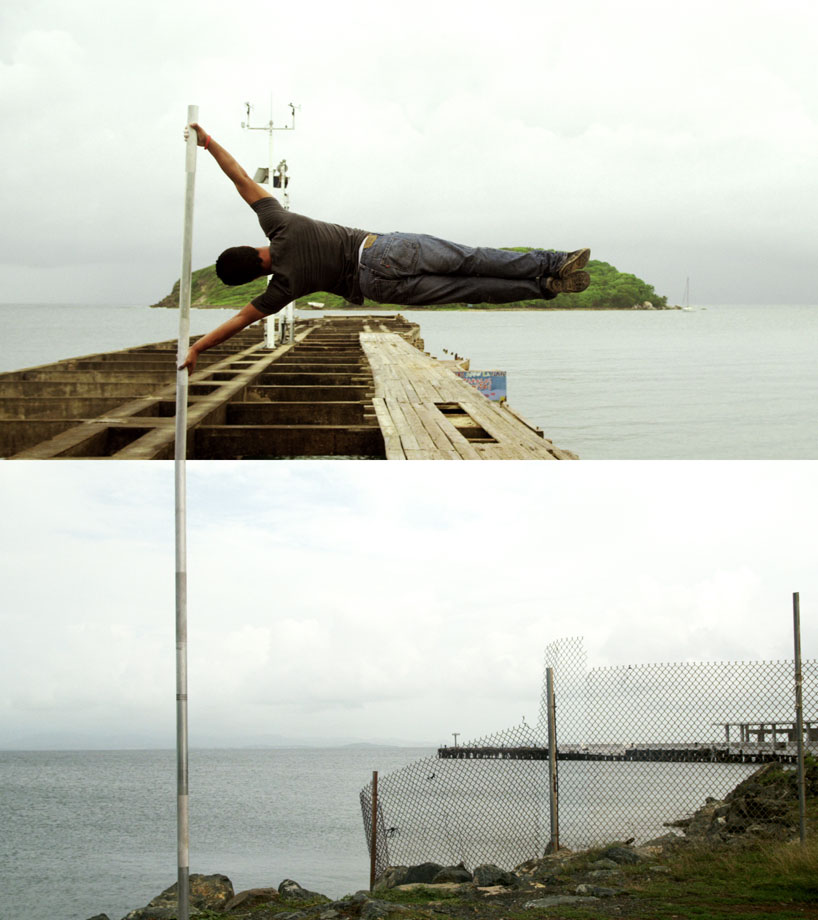
For the Biennale, Allora and Calzadilla present Gloria, a five piece exhibition deeply concerned with what it means to be American today, specifically focusing on competition, condition, and display.  The upturned tank of Track and Field immediately imposes upon the entire Biennale with its size and incessant racket.  A figure poised atop a pedestal, US Olympians alternate running in place.  Indoors, two gymnasts perform choreographed routines upon sculptural reproductions of first-class airline seats.  In this, Body in Flight, the theatrical quality of the gymnastic routine is dislocated to the confines of a small gallery room where dramatic display becomes excessive and uncomfortable, USA emblazoning across uniforms, while still maintaining the allure and beauty of accomplishment and skill.  Algorithm is a custom-fabricated organ fashioned to play in direct response to a built-in ATM machine used by visitors to the pavilion.  It sings and glorifies a unique composition for each individual transaction.  Armed Freedom Lying on a Sunbed is exactly that, and painfully literal. This is when it gets apparent that they were trying to do a lot in a short amount of time. The exhibition wraps up with Half Mast/ Full Mast, a video continuing the collaborators’ series on the Puerto Rican island of Vieques, which the US Navy used as a military base and bombing practice range after relocating citizens.  Through a fractured frame, the video shows a man lifting himself horizontally in place of a national flag over different cites relevant to the island’s historical struggle for freedom and rights.

On the whole, I have mixed feelings about Gloria.  I respect what Allora and Calzadilla are trying to do.  These pieces are loud and aggressive, and some things they do well.  The absurdity is often effective, creating a disturbing middle ground between horror and humor.  Using the belligerent and imposing nature of US policymaking and military strategy as a method for presenting artworks creates a painfully tangible affect, holding a mirror up to the beast, and they function as critique that way.  But is it dangerous for an artist to adopt the methodology of the system they critique as a means to build metaphor?  My concern is that in the overstatement and imposition that mirrors American systems, the work itself, perhaps its poetry, becomes cold, calculated, overly didactic, and hyper-aware of its diplomacy, its many ways of relating to the international viewer.  Surely art-making requires its distinct way of functioning to function well.

I also wonder if there are epic contradictions in the cost required to produce these grand, perfect objects of “American art” that then critique consumerism with an ATM, indulgence and narcissism with a tanning-bed, and capitalist imperialism with a tank.  It’s a tank!  Do you know how much that cost to get to Venice?  Only the USA would do that…right?  So in mimicking, do Allora and Calzadilla’s works come close to committing the crimes they condemn?  Does the work lose power associated with the artists’ individual methodologies by adopting another system’s?  Or is the artistic gesture and the final product worth that sacrifice?
-Katie Smither

Thursday, May 26, 2011

Review: The Nine Eyes of Google Street View by Jon Rafman, or Veritable Objective Collective Soul Earth Family Photo Album


/ / / / / / / / / / / / / / / / / / / / / / / / / /
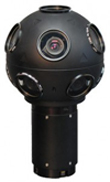
Before time, before you were born, and before your mother and mother’s mother were born, (in 2007) Google, IRL, emailed a fleet of cars o’er the land with the goal of documenting the street views of the world, street level. Each car a carriage with a pole fixed with nine cameras; each camera indifferent to art, art history, and the human experience; each camera a nebula ball that rests in a google fantasy claw.


Jon Rafman's Google Street View installation in gallery setting.
GOOGLE BALL RESTS IN FANTASY CLAW
The Nine Eyes of Google Street View is a project by Jon Rafman, a Montreal-based artist and Paint FX club member; the project is an indelible collection of images gleaned from Google Street Views. Google street view is a subset of Google Maps, comprised of images captured by a nebula ball camera mounted atop a moving vehicle. It looks like, well, you know, one of those nebula balls that rests in the fantasy claw, except it moves around the world snapping copious photographs. The resulting images are typically mundane, because the nebula ball exists to capture and upload informational and topographical imagery for Google. The nebula ball does not pursue art; however, there are instances where the nebula ball (unintentionally) renders fine-art: images remarkably within spitting distance of the pure human experience, and quite well nigh to artistic objectivity. Rafman’s project is Rafman’s subjective aggregation and presentation of these special moments, via internet and post-internet.
By dint of Rafman’s curated 9-eyes.com collection, the participant opens a leather-bound book that might as well be titled, “Mother Earth’s Family Photo Album,” inasmuch as we are all living together, here on earth, as one big family — an unfathomably large family — with 6,835,508,543 mouths to feed (as of 12:11am on 5.19.2o11, vide this graphic, rendered by this source): we are family, we are happy and mad, we are capricious, tempestuous, and sad; a disfunction with a function ; a family, here on Earth, together at this present moment. So, with altruism, let us all hold hands and form a hand-holding chain around the earth, because this likely will alleviate all the ills of this difficult human experience . . . the sense of accomplishment, too . . . I mean, wouldn’t it be nice to say, “Hey, we did it! Finally, everyone on Earth held hands to wrap around and give the Earth a warm hug.” Obviously this was the impetus for Michael Jackson’s “Black Or White,” “Man In The Mirror” and “Heal The World,” or Agularia’s masterwork “Genie In A Bottle,” or Kool Aid ’89, and the Chicago Bulls dynasty of the ’90s, go Bulls.
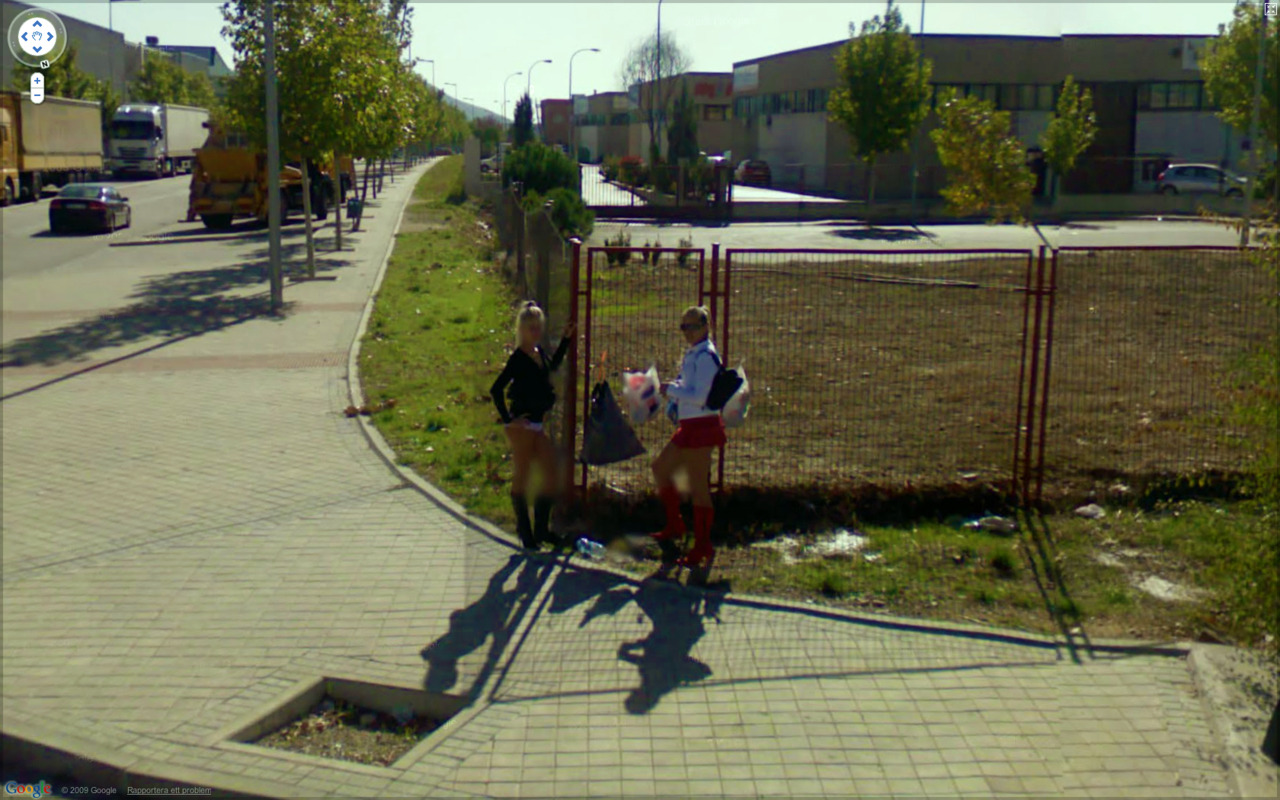
Back to the Nine Eyes project, the participant journeys and cruises the streets of the world — images, visual artifacts — from country to country, from coast to coast, from truck stop prostitute to prostitute, from vagabond crawling babies to friendly guinea pig walkers — all moments that define our collective conscious and unconscious human experience.
Take the time to stop and smell the pixeled flowers of the 9-eyes.com webpage: you might find that the curated images evoke a visceral feeling; moreover, a profound sense of spirituality tinges: the profound sense of spirituality that we all experience every day, every night, this human (and much more than human) experience that we call death and that we call life. Sex, drugs, guns, murder, death, disease, hockey, knee surgery, wet jeans, earning Gs, jet-skiing off the coast of a coast of the coast of the Andes — moments like these are found by the google vehicle and viewed by many, but Jon Rafman sedulously devoted his time wandering, cruising, screen-capturing, surfing.
Rafman inevitably went Post-Internet with this project: the selected images are screen-captured, blown up to a very large scale, and mounted on a wall for gallery presentation. The project makes a graceful crossover. John Rafman’s Nine Eyes of Google Street View is brilliant project; thoughtful work that congeals the four corners of the internets’ imagery, a pleasing contrast to the meretricious, impetuous and vapid work of his Paint FX crew. Nine Eyes is an outstanding accomplishment of new media art: it’s net art with a concept that appeals to the multitude, inasmuch as it is google, and most people have heard the word google and most people understand the services google provides.
With sophisticated execution and vision, the Nine Eyes project initiates Rafman as an august figure and trailblazer of the incipient net-art and post-internet art movements vis-a-vis the overall ethos of new & experimental media today, 2011.
Below are 14 selected images from http://9-eyes.com:
More: