Showing posts with label poetry. Show all posts

Sunday, February 5, 2017

Poets on Poetry: Signe Swanson and Julia Madsen


Signe
Can you tell me a bit about your personal journey to where you’re currently at as a poet? How did you get started writing ↦ present day?

Julia
I've often felt uncomfortable talking about myself, in my writing or otherwise. In the Midwest, and perhaps Iowa in particular, where I’m from, there's this thing about extreme humility and humbleness. It's very Protestant I think. But lately I've been trying to break out of this, in my writing at least. I always think of this quote from Richard Hugo's “Writing Off the Subject” where he says “to write a poem you must have a streak of arrogance, not in real life I hope. In real life try to be nice.” Right now, my writing and film work is centered on where I’m from and the landscape, people, and stories that were there with me. I would go into more detail, but at the moment I’m a little protective and afraid to jinx it, so to speak. It’s been inspiring to do this work, and has felt productive in a new way. I would say that my work has moved toward documentary poetry and the personal essay.

I grew up in a rural Amish town with a population of roughly a hundred. My old computer would barely turn on, for the longest time we didn’t have television, and there were no video games or anything like that. It was very quiet. Silence was everywhere, sometimes peaceful and other times it would eat you. But it was a productive locus in which to read and write. A slowness rotating in the field. It’s how I mainly occupied my time.

As an undergrad I became particularly obsessed with poetry. I would check out something like thirty books of poetry from the library each week, trying to read as much as possible and writing when inspired. That kind of obsession. A lot of self-teaching. But at Brown, of course, I came into contact with electronic writing, which was pivotal for my thinking, writing, and creative practice in general. I’ve always had a strong interest in film and visual work, and my experience at Brown really incited me to pursue this. I took a brilliant course on essay film with Carole Maso that planted the seeds for the project I’m currently working on, which is essentially an essay film. And of course working with C.D. [Wright], Forrest [Gander], and Cole [Swensen] was absolutely insightful, and I am so grateful and appreciative for the time I had with them. C.D.’s documentary work in particular continues to echo and reverberate, it’s like a steam train that’s always coming down the tracks, rattling skulls and windows and anything else that might break. That’s the power of her language.

Signe
Something I have at times struggled with is how accessible to make my poetry. I feel like poetry missed me before coming to Brown because it was an abstraction too removed from the immediacy of my home culture, and I sometimes fear that as I grow to be deliberate with language I lose something with people at home who have thick accents and use a lot of idioms, haha. Have you ever felt this way? Could you speak a bit to the experience of working class language as it relates to poetry?

Julia
I’m so pleased to hear that you’ve come to poetry, and are thinking about important issues like class and voice – issues I certainly think about as well, and I think it’s safe to say that, as you know, there are no definitive answers. But this is where, to my mind, the role of the documentary and documentary poetics comes alive. I am so inspired by the work of documentary poets like Mark Nowak, who focuses on class and capitalism. I love Shut Up Shut Down and the way he uses the archive as a means of gathering and amplifying working class voices. In my practice, documentation involves inquiry and question asking. It involves research of all kinds, including talking to people about their daily lives and experiences. I’m genuinely intrigued by people and their stories and the way they tell them. In interviewing people from home, there’s something very grounded in the experience, perhaps different from the abstraction to which you are referring. Although, as I’ve already touched on, this is somewhat of a newer practice for me. In the past my work has been more theoretical, conceptual, etc., and in many ways it still is. I think that all of these registers are important for me to feel like my practice is running on all cylinders, so to speak. But certainly there are rarefied, sequestered, removed, and privileged aspects to the history of poetry that I’d like to think can change and are changing. 

Signe
In relation to the last bit, I’ve definitely struggled in the past with relying on place in my poetry. I think a lot of first-generation college students at Brown feel an attachment to place and local identity in a way that reflects class anxiety, or at least that was a big part of my freshman year experience. This semester I’ve been really interested in the poetics of place, namely reading William Carlos WilliamsPaterson, Charles Olson’s MaximusPoems and Daphne Marlatt’s Steveston, all of which instrumentalize working class language/identity in a kind of unnerving way. How do you conceptualize place as a poet?

Julia
Oh, I love all of those books you mention! I’m really glad to hear that you are thinking about the role of place alongside such tomes and compendiums of fluorescent poetry. Susan Howe is another poet I admire whose work has focused on place and documentation. I’ve watched so many brilliant essay films on place—Ross McElwee’s Sherman’s March and Guy Maddin’s My Winnipeg come to mind. And of course Robert Smithson’s work on location. Place is such a character, isn’t it? A place has history and is haunted by history. A place ages, changes, develops, degrades. As a first-generation college student I absolutely understand feeling an attachment to place and local identity, as you mention. I think that this is an attachment out of which evocative art can be born. It’s a sort of passion. There’s so much beauty in local identity or what one might deem commonplace. There’s much to uncover and/or recover, as well as that which simply cannot be uncovered or recovered. The Production of Space by Henri Lefebvre and Postmodern Geographies by Edward Soja have been pivotal for me in thinking theoretically about space, place, and social issues like class. Baudrillard’s America and Bachelard’s The Poetics of Space, too. A lot of my work on place comes back to something very simple, I think, and that’s the American Dream. David Lynch’s films are useful in meditating on this. The places I am drawn to seem to simultaneously (and curiously) uphold and show flaws inherent in the American Dream.

Signe
A more general question: how do the various communities you’re in, influence your writing process?

Julia
I could begin by talking about my family and community back home—a community that certainly influences me visually. So many moments and images from childhood and home crop up in my mind when I’m writing and working. It’s both settling and unsettling. There are dark moments. I suppose I could broadly define this as the Midwestern Gothic. It’s hard to describe the feeling of sleeping alone in an old creaking farmhouse with nobody around for miles. And what if a stranger rings the doorbell in the middle of the night? That’s happened. It splits the silence. And of course worse things happen—you don’t need to look far to find what the fields and snow and silence covers, you just have to look. Being back in academia at the University of Denver and the poetry community here has been so helpful in thinking about the importance of our stories, even when we think that they’re somehow not good or interesting enough. It has allowed me to sharpen my instincts.

Signe
While reading “LATE-NIGHT TALK SHOW BEGINNING WITH COMMERCIAL” I started thinking about private versus public thought and experience. How do you see the line between public and private manifesting in culture and in poetry’s reflection of culture?

Julia
I am very influenced by the Situationist movement and theorists like Guy Debord and The Society of the Spectacle. When I think of the public sphere I tend to think of mass media and Debord’s focus on the social relationships between people that are mediated by images. In the poem you mention, there is, to my mind, a blurred distinction between public and private in relation to mass media, the latter of which relies on the visual, the spectacle. The image, broadly speaking, is endlessly fascinating to me. It is both outside and inside—our capacity for vision is a complex relationship between the outside world and the function of our brains. The poet Ronald Johnson has a great interview with the filmmaker Stan Brakhage where they discuss the evolution of sight from the reptilian brain—something about how light created the capacity for sight. I love the image of light pouring onto the ancient, reptilian brain. And this is perhaps how mass media attempts to get ahold on the life of the mind, our innermost thoughts and desires. This is how mass media can liquidate us.

Signe
What do you think technology’s role is in poetry: now and in the future? Do you see technology impacting the accessibility of poetry?

Julia
I’m thinking of a quote right now from C.P. Snow, that technology brings you gifts with one hand and stabs you in the back with the other. Which reminds me of Derrida’s essay on technology as pharmakon, both cure and poison. To illustrate his point he discusses written language and documentation as a technology and prosthesis for memory that actually enables us to forget. And then there’s Heidegger digging deep into the meaning of techne as poesis and “bringing forth.” Both technology and poetry are acts of bringing forth, of revelation. How can they work together to bring forth stories, images, voices, etc., in innovative ways, and how can they work to disseminate these in ways that might increase poetry’s accessibility? I think there are many answers and the question itself excites me!


•••

Signe Swanson is a second-year student at Brown University, where she is studying Literary Arts and Comparative Literature. Her writing is influenced by her experiences with place, class, and translation.

More of Julia Madsen's work can be experienced >>> here


Tuesday, August 12, 2014

from TRISTE TRISTAN by Paol Keineg

Tristan and Isolde; Salvador Dali (1944)

from TRISTE TRISTAN by Paol Keineg
trans. from the French by Rosmarie Waldrop


Tristan, Iseut, etc.
take nudity by storm —
the poor girl has escaped,
bursts of hate
all around the woods,
and the burghers
end up with a beautiful wedding,
the dog taken in with the loot —
the gift of oneself estranges the self,
we’d like to ruin
these militant lovers.

Sunday, July 27, 2014

Form Submission; Form Rejection

by Andrew E. Colarusso

Many among the thousands of us who write poetry, or assume the title of poet--in fact, all of us who have considered the possibility of an original creation being actualized in this world have also contended with rejection. It's natural to every process. We are continually engaging and negotiating the corners of our lives with varying degrees of success. But for poets (and writers in general) the rejections seem to come several at a time and consistently. This is part and parcel of the job. 

A poet asserts an idea or an aesthetic while adapting process to reach an objective aim. It's a constant push and pull, swinging back and forth between a necessary obstinance and amenability. And the poet herself is subject to much discussion and classification, especially with regard to creative output and aesthetic. i.e He's formal and lyrical; she's a feminist poet; they make conceptual pieces; we strictly write for the page. I'm doing my best not to place poets within an objectifying binary (hermetic/populist, tradition/vanguard, demotic/hieratic) Poets universally engage process, and a part of that process is dealing with the consequences of our submissions, dealing with the ways our work is received. We all get rejections...

Thursday, July 10, 2014

Waste Land: A New Literary Experience


Waste Land

Waste Land is an immersive world, a mystery waiting to be unraveled. Designed by Remo Arpagaus, principle designer at White-Ibex Games, and curated by Andrew E. Colarusso, editor-in-chief of the Broome Street Review—Waste Land bridges poetry and game design to create an all new interactive literary experience. The first of its kind!

Tuesday, March 25, 2014

Poem

Mikhtam
 by Andrew E. Colarusso 

A Sort of Homecoming, 2011
Cut paper on birch panel with UVA varnish
36 x 71 inches (91.4 x 180.3 cm)
Courtesy Andrew Edlin Gallery


Mikhtam

The clime touched down on weathered twine
tied to the hind to maginal wire and the secular
to a tuft of red hair. Native in the din easygoing
mayfolk bedgotten by march to make december
babies

Begin flagging for settlement. The hold is loosened
into a comfortable and plural slouch as one foot in
front of the other we who still stand now in the cycle
of anotherworldly condition pour into the eye into
the smell of

The secular. Maria turn against what borrowed light
we watch and gampless against the coming eyewall
whiten all reflex in preparation for what. Whiten
in my ear your breath behind me without saying
you

                                 Begin flagging for settlement
as the first thing you said when you saw it was


for Afia K

Wednesday, February 19, 2014

An [Abridged] Introduction to Parapoiesis

Having Walked Beside the Devil:
An [Abridged] Introduction to Parapoiesis


I.
Awakened from your shepherd’s dream by a curious and questioning devil (שָׂטָן). You find yourself walking at your own pace beside the devil, who walks also at your pace, amused, engaged, uneasy. Enthralled. You experience beside the devil an arousal of doubt. You choose to acknowledge this or you choose not to. “On the whole, the very mark of my genius is that Governance broadens and radicalizes whatever concerns me personally.” says the devil.  (Kierkegaard)

II.
The devil does not ask in earnest curiosity out of Gnostic ignorance. The question functions as the opening gambit of a small play which leaves you uncertain, fearful perhaps, and trembling (יְהוָ֛ה בַּדֶּ֖רֶךְ לְשָׂטָ֣ן ל֑וֹ וְהוּא֙). You witness, for example, your beloved in conversation with another—a familiar face whose name escapes you. Your beloved is smiling in a way you know to be intimately yours. You had believed, until this moment, that only you could make your beloved smile in this way and this knowledge, once secure, was the gem of your evenings before sleep. Something whispers so near the core of your being that you can’t tell where it comes from. You are aroused. You are aroused to apprehend the distance that has already come between you and your sense of security. Then the devil whispers (וַיַּ֧עַן הַשָּׂטָ֛ן אֶת־ יְהוָ֖ה) into your ear 


III.
The eros of this space is sublime, so wide as to let in ideas and concepts the size of nations and universes of possibility. Like Paul Celan walking beside Heidegger in relative silence at Todtnauberg, hungry for some affirmation beyond the soft music of the Arnica and Eyebright, the Orchis he was certain to point out for the philosopher. Certainly they spoke on their walk, but it is unclear whether the scion of German poetry (a holocaust survivor) and the bearer of the German intellectual tradition (a passive* participant in the horrors of the Third Reich) ever broached the subject of what settled in the historical space between them. 
Was Celan’s life ultimately worth the silence he lived with? Had Celan and Heidegger spoken earnestly of the abyss between them, the same dense matter that drew them together, what would one or the other or both have had to sacrifice in order to propel a healing discourse? 

IV.
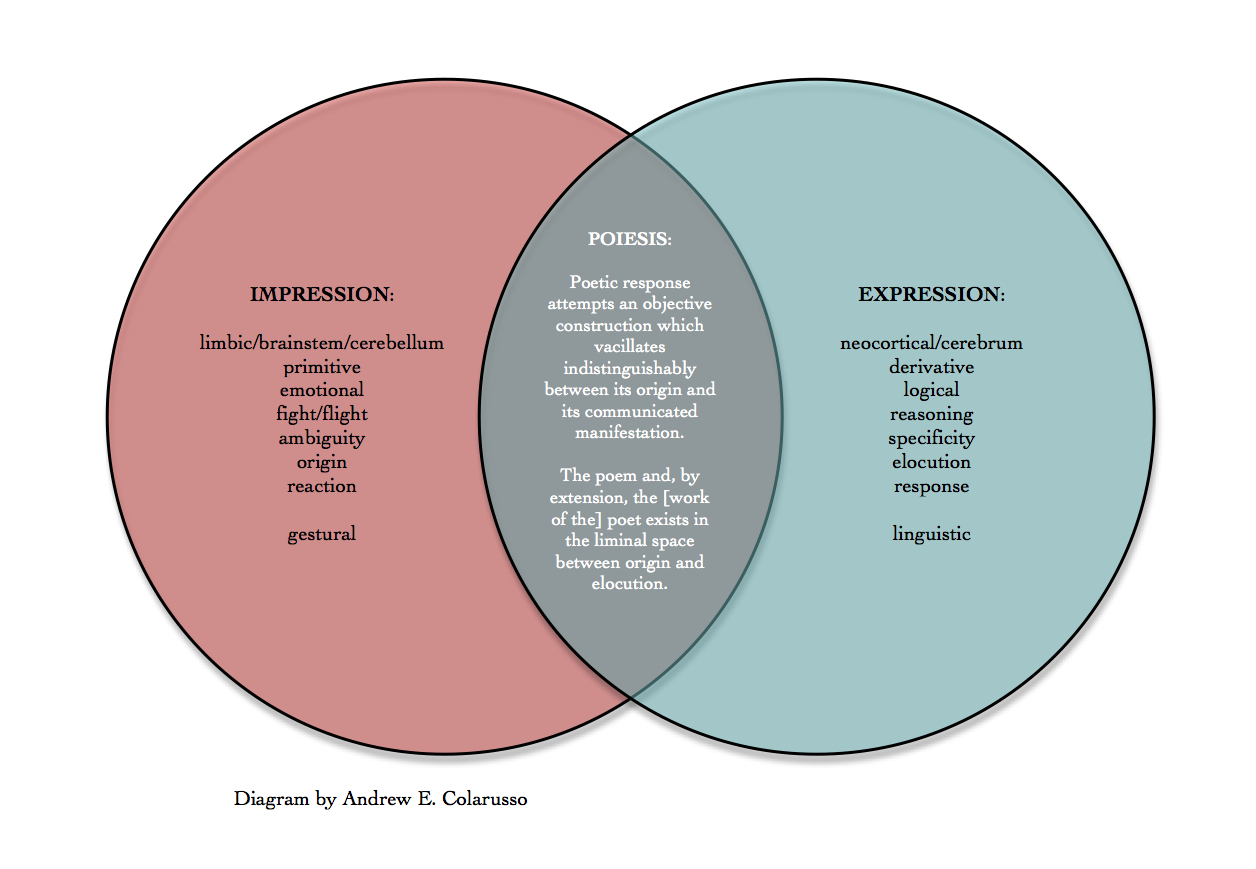
The poetic impulse is this transverse traversal of perceptive phenomenon. It begins with limbic impression which itself is ambiguous and wells from the most primitive portion of the human brain. These basal impressions are prompting. The poet is bound to the observation of her primal or basal nature. The poet is primitive and the work of the poet is this necessary transversal by which we as a collective whole come to understanding of being and origin. It is the impetus for invention and, by extension, intervention. “Anyone who experiences anything primitively also experiences in ideality the possibilities of the same thing and the possibility of the opposite. These possibilities are his legitimate literary property. His own personal actuality, however, is not.” (Kierkegaard) So it is that these impressions, or the impression, is always original without ever being new. It is common. It is familiar. It is commonly original. 
Celan’s poem, Todtnauberg (written 1 August, 1966; posthumously published 1970 in his collection 'Lichtzwang'), commemorating his now [in]famous meeting with Heidegger, is full of longing for a music beyond that of the flora which only bears witness without affirmation. Flora, for all of its beauty, is unable to apologize, to reconcile différance. Flora belongs to the sublimity which humanity finds itself arrested from. The Arnica and Eyebright (ger: Augentrost), our ingress into his poetic retelling, prefigures the cruelty of this sublime silence. The Arnica and Eyebright, the Orchis, which signifies the transubstantiation of the body of Celan’s non-nation (like Edelweiss in The Sound of Music), cannot say “You’ve suffered. Please come inside. Rest a while. Allow me to apologize. We shall suffer and survive together.”

V.
If the poetic impulse begins with impression, it then finds expression in neocortical synapses. Impression/feeling is given over to language and more complex processing by way of signs and signifiers so that the feeling may be apprehended and communicated to like of our species. Apprehension here does not, however, imply comprehension or even an arrest of feeling. You go on feeling. And feeling, being original, needs supplement. 
“His speaking and his producing are, in fact, born of silence. The ideal perfection of what he says and what he produces will correspond to his silence, and the supreme mark of that silence will be that the ideality contains the qualitatively opposite possibility.” Kierkegaard’s silence here is limbic in origin. It is primitive feeling which in its private ambiguity elicits basic linguistic, even poetic, returns. The difference here being the immediacy of reaction as opposed to premeditated poetic response.  Reaction is, by dint of its happening, carceral. Response is an opening toward reaction or like response (i.e. dialogue/ transmission/ manumission). Imbued in the poetic response is both the affirmative and its negative, engendering the sublime infinitude of possibility.
So this transversal begins with basal impression and attempts to become entirely potential in a calculus of language. But language, as a mode of expression, like light energy, travels as both wave and particle. “Sometimes…instead of becoming welded together, words loosen their intimate ties.” (Bachelard) So it is that these expressions, or the expression, shifts invariably toward newness without ever being original. It is invasive. It is self-conscious, self-reflexive, and asymptotically diminishing in pursuit of its origin. It is its own telos. 

VI.
This, from Lyotard's Differend, sojourns with us in dialectic thought ”…the unstable state and instant of language wherein something which must be able to be put into phrases cannot yet be… the human beings who thought they could use language as an instrument of communication, learn through the feeling of pain which accompanies silence (and of pleasure which accompanies the invention of a new idiom)". Basal impression (with its origin in primal impulse) as it is brought into shared space by external expression (that which is in a state of constant revision to better apprehend its limbic origins), has need and use for synthetic supplement. This is our recourse to poetry and parapoetic document. So long as we are defined by our finitude, poetry will fulfill its purpose as the mode by which we are and through which we become. 
Apart from its mediated graphing, poetry is a matter of coherent scope, of seeingThe poet is guiding (poiesis) a certain construction (toward object, parapoiesis) on ever-shifting terrain. As such the construction itself is uncertain and the terrain, the strictures which govern the object's making, certain to change. Because the terrain of language is unstable and its origins in basal need consistently present, the parapoetic object attempts a vacillation between its origin and its communicated manifestation—invention or intervention by way of the synthetic, of simulacra; which is then to say, sometimes only you know the purpose of the object you've created. And that, as a declaration of function, is enough. 

VII.
It is already made. The primacy of our object-oriented poiesis here displaced and contextualized as a remainder of physis, or the “…pure potential to produce and disappear in [the] production. This is nature’s ideality that the new art wants to materialize in its simplified forms: in the graphic tracing of a poem, the silence of a dialogue, a bursting surface, the movement of a statuette, or the floral decorations of a piece of furniture.” (Rancière). The poem and, by extension, the [work of the] poet exists in the liminal space between origin and elocution—has no express relationship to material (as would an artist), choosing instead to commence from and remain with the immaterial. 

Because poetry is nobody, poetry is constantly seeking its proper body. [Modernism declares that] poetry exists in perpetual desire of its form. Out of such thought, the parapoetic object is actualized in this transubstantiation (via poiesis) from the epistemological into the technological. How ideas become words, how desires are fixed to bodies. And once the poetic has become the parapoetic, once epistemology has become technology, the object achieves its own governance, performs the poet's labor autonomously, carries potential for resistance. 


The resultant parapoetic object is akin to the formation and/or discovery of an adequately absorbent black body. 

VIII. 
When the devil calls you to question, you are bound to respond/react

The witnessing Eyebright of Celan’s Todtnauberg, for example. The object seized upon vouchsafes security against a sort of violence which is endemic to life and living. Sometimes it becomes necessary to erect a dam in order to prevent flooding. Consider the erection of a bridge. The poetic object may function in this way. An elocution against impossibility.  

IX. 
Is it possible to bear witness for the sufferings and spectral ingestions of a black body—the life of the poem which actualizes being by vacillation between origin and elocution? When asked by Gerhart Baumann, a professor at the university of Freiburg, if he’d attend one of Celan’s readings, Heidegger responded:

“I’ve wanted to become acquainted with Paul Celan for a long time. He stands farthest in the forefront and holds himself back the most. I know all of his works, also of the serious crisis from which he managed to extricate himself as much as a person is able. You are correct in interpreting how helpful a reading here would be. July 24 would be the best date for me…It would also be healing to show P.C. the Black Forest. Recently I found a new volume of his poems advertised: Atemwende.” (1966)

It is clear, by most accounts, that Heidegger mounted a concerted effort to greet the poet with measures of hospitality. In fact, before Celan’s arrival, Heidegger called in a favor from a friend and book-dealer in Freiburg. Heidegger asked him if he’d contact other book vendors in the area and have them put Celan’s works on display. Accompanied by Baumann on a walking tour of Freiburg, Celan was pleasantly surprised to find his work “…on display in every major bookstore window. He had no idea, however, that Heidegger was responsible for these displays.” (Lyon) Also, by most acknowledged accounts, Celan’s mental health appeared to improve noticeably, if only for a brief time, following his visit with Heidegger. 

X.
It is physically impossible to perceive, to be presented with, every detail of the story, so to speak. But the poet attempts to ingest entirely and with serial conviction the world in which the story takes place. These worlds-to-be weigh on the poet—this potential within a calculus of meaning, whispered into your ear. 


5/31/2013

Edited 7/10/2015
Edited 2/23/2016

Wednesday, September 26, 2012

Theory by Hermine D. Pinson

Theory

a woman sits in an attic for seven years
she is not rapunzel
                              perfect

in the heart of a galaxy
130 million light-years away

there's a hole as big
as the orbit of mars

a hundred million suns
have fallen
into it

nothing escapes
it's perfectly black

as the poet's night
falling gently

as steal away
the last note and after
on the general's tongue

as even a man
darkens newspaper margins
completing a letter in a birmingham jail

                 perfect

the dancer's
god-driven legs
her gran jetés

                 revelation

they bent time
collisions of stars
each spiral
its own orbit
at the galactic core
of the matter

perfect

hambone hambone
where you been
round the world and
back

as a woman sits in an attic
so
a man sits in a hole
strung with ten thousand lights
he thinks his story through


*first published in Cave Canem Retreat Anthology VII, 2002/2003 ISBN 0970977026

Hermine Pinson has published three poetry collections: Ashe (Wings Press), Mama Yetta and Other Poems (Wings Press), and Dolores is Blue/Dolorez is Blues (Sheep Meadow Press). She also released a cd, Changing the Changes in Poetry & Song, in special collaboration with Yusef Komunyakaa and Estella Conwill Majozo (2005). Her poetry, fiction, and critical essays have appeared in anthologies and journals such as CallalooVerseCave Canem Poetry AnthologyThe Ringing Ear: Black Poets Lean South,African American ReviewCommon Bonds: Stories by and About Modern Texas WomenEyeballKonchMelusPaintbrush Forum for European Contributions in African American Studies, and will soon appear in Richmond Noir. As associate professor of English, she teaches creative writing and African American literature at the College of William and Mary. Purchase her books here and here, and her collaborative cd here.

Thursday, August 16, 2012

The Broome Street Review no. 5 now available!

Hey All,

Be sure to pick up your copy of TBSR no. 5. It almost looks as nice as Amber Rose. 

Check out our new site and a sweet deal 
>>> HERE  <<<

photo of the parking lot on Broome by Michael George

Saturday, May 26, 2012

Love After Love by Derek Walcott

The time will come
when, with elation
you will greet yourself arriving
at your own door, in your own mirror
and each will smile at the other's welcome,

and say, sit here. Eat.
You will love again the stranger who was your self.
Give wine. Give bread. Give back your heart
to itself, to the stranger who has loved you

all your life, whom you ignored
for another, who knows you by heart.
Take down the love letters from the bookshelf,

the photographs, the desperate notes,
peel your own image from the mirror.
Sit. Feast on your life. 

Sunday, August 14, 2011

Langue d'Oc


By Ezra Pound from the collected Personae. (New Directions)

Saturday, June 11, 2011

Michael Harper, Glenn Ligon and the Assertion of Black Male Identity


(above) Michael Harper: "Brother John" from dear John, dear Coltrane (1970)
(below) Glenn Ligon "Untitled" (1988)

Sunday, January 23, 2011

An Ode

On the train platform in the middle of a long and incredibly beautiful, spiritual day I thought of Wallace Stevens. A good friend of mine accused me once of being "a" Wallace Stevens (in regard to my poetry and my being as poet)--a hubristic, masculine energy. In high school I was a student of Cummings, though frequented brothels of Eliot and Stevens. The great white sharks of modernist American poetry. In the 12th grade Mr Milkman would explain to me, once and for all, the meaning of Stevens's "The Emperor of Ice-Cream" and I would come to believe then, as now, in Shelley as the greatest of the Romantics (discounting my own, superior-because-I-am-alive Romanticism with a capital Rrrrawr)

The Emperor of Ice-Cream (Harmonium, 1923)

Call the roller of big cigars,
The muscular one, and bid him whip
In kitchen cups concupiscent curds.
Let the wenches dawdle in such dress
As they are used to wear, and let the boys
Bring flowers in last month's newspapers.
Let be be finale of seem.
The only emperor is the emperor of ice-cream.

Take from the dresser of deal,
Lacking the three glass knobs, that sheet
On which she embroidered fantails once
And spread it so as to cover her face.
If her horny feet protrude, they come
To show how cold she is, and dumb.
Let the lamp affix its beam.
The only emperor is the emperor of ice-cream.


And I could never forget his final conclusion, his ingenious interpretation having been deeply incorporated into my being. I know the emperor through an ombudsperson. And today finally I can be the emperor. I felt. I am the emperor of ephemera. It is likely that if you are reading this, you too are an emperor of delicious ephemera. The first stanza is so much an ode to man. The second stanza complicates the first in it's invocation of "her" and "she". Foil to "the muscular one" in the kitchen, cooking up the familial medicine. Ice cream. Contemplate Ice Cream. Let your imagination create the ice cream; the ice cream that should be as creamy and rich. Later, he will meet her in bed. Not the sort of bed one would sleep comfortably in. An incredible shift of mood and setting that stands as a testament to the genius of Stevens.

-Andrew E. Colarusso

Wednesday, January 19, 2011

His true Penelope was Flaubert


My sister would destroy me with chiding laughter for this, but I have to admit--I loved the film Julie & Julia. It's an incredibly relaxing film for me to watch as a writer, an epicurean--a boy who grew up watching Great Chefs with his mother while doing his homework. Lydia Bastianich is a saint. But I'll be damned if anyone says her Risotto trumps my own, original recipe.

Anyway why do I love Julie & Julia? It appears, at first glance, to be just a chick flick. The dialogue is weak, the voiceover pathetic and Julie about as irritating and whiny as Holden Caulfield. But the film carries an intelligent discourse on modernity with an incredible performance by Meryl Streep as the illustrious, pickled American-French chef, Julia Child. Anyway I'm a sucker for chick flicks. I enjoy watching the creative quest, undertaken by Julie, unfold and secretly (no more a secret) I root for her to accomplish what she's already accomplished in real life. I enjoy the biopic flashbacks to Julia Child in France and her learning experience while cooking at an under-ripe Le Cordon Bleu. I love food. I love cooking. And I feel for Julie & Julia both in their quest to be published authors, recognized writers. Another, more deep rooted joy I find in the movie, is the discussion of building a home. The environment is crucial to a writer. So the homemaking aspect of this film really gets me--it touches a dream I have. A dream, perhaps, we've all had of a home--the home. A dream I've had for a long time. A dream that's manifested itself even in hallucinogenic trips on varied sudsmachines. It's deep. This film appeals to something deep within me. But I realized a very interesting thing on this, my fifth viewing of Julie & Julia.

The reason Julia Childs' flashback scenes are more fascinating, aside from the reconstruction of an old, romantic Paris is the fact that Julia is mixing it up. The character of Julie is lost, and finds herself through the corpus of Julia Child. Julia Child is lost, so she undertakes an unwritten quest. Two different odysseys reflecting a transmission of information and, more importantly, the technology that comes to define an era.
(here's where it gets post-modern) Julie is hopelessly fixed on blogging her experience, extracting a thin pleasure from every comment she receives and every potential reader. Instant gratification--the dopamine squirt.


Heaven Goes Online

When the sidewalk's eyes were weeping
when snowflakes burst from the pillows
as the mayor talked from the bottlecaps of his ears
& the old women dusted off their beauty marks
when the graffiti artist's hand became a saffron scarf
when the breeze flashed its grilled teeth
& the sun torched the forest to a moon
when sad Amelia pierced the clouds in her veins
when my lips gathered at the beaches of your lips
& my tongue at the on-ramp of your spine

-Poem by Major Jackson
Holding Company 2010 W.W. Norton

-Andrew E. Colarusso